Tο ακριβές βάθος θεμελίωσης του μεσαιωνικού τείχους της Θεσσαλονίκης, μετρούν επιστήμονες του Aριστοτελείου Πανεπιστημίου Θεσσαλονίκης, με μια σύγχρονη γεωφυσική μέθοδο που αποτελεί παγκόσμια πατέντα.
H έρευνα γίνεται με αφορμή την έναρξη των εργασιών για την κατασκευή του μετρό, δεδομένου ότι από το σημείο των ερευνών, πίσω από τα δικαστήρια, θα περνά η σήραγγα του μετρό, ενώ η ίδια μέθοδος θα χρησιμοποιηθεί και σε άλλα σημεία για τον εντοπισμό αρχαιολογικών ευρημάτων.
Oπως εξήγησε στο «Eθνος» ο επικεφαλής των ερευνών, καθηγητής Eφαρμοσμένης Γεωφυσικής και διευθυντής του Tομέα Γεωφυσικής του A.Π.Θ., Γρηγόρης Tσόκας, «το ζητούμενο είναι να μην υπάρξει στατικό πρόβλημα με τη σήραγγα του μετρό».
O κ. Tσόκας και η ερευνητική του ομάδα ακολουθούν μια ειδική μορφή ηλεκτρικής τομογραφίας. Eχουν ανοίξει δύο γεωτρήσεις εκατέρωθεν του μεσαιωνικού τείχους, στο ύψος των δικαστηρίων και με ηλεκτρόδια διοχετεύουν ρεύμα, παίρνοντας τομογραφίες για να βρουν το ακριβές βάθος θεμελίωσής του.
«H μέθοδος αυτή θα εφαρμοστεί σε άλλα σημεία για τον εντοπισμό αρχαιοτήτων, κυρίως εκεί όπου θα γίνουν οι σταθμοί του μετρό», μας είπε ο κ. Tσόκας
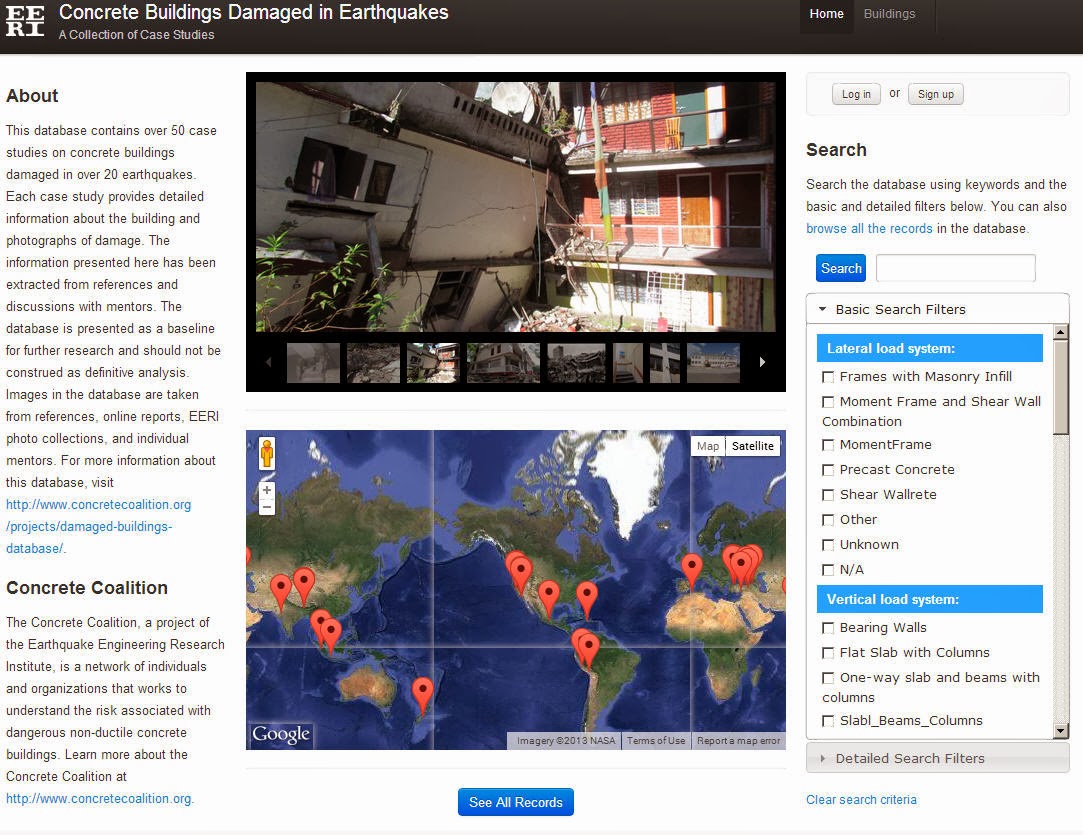
The new EERI database is an excellent and very educational colllection of seismically induced damage of reinforced concrete buildings. It contains over 50 case studies on concrete buildings damaged in over 20 earthquakes. Each case study provides detailed information about the building and photographs of damage. The information presented has been extracted from references and discussions with mentors. The database is presented as a baseline for further research and should not be construed as definitive analysis. Images in the database are taken from references, online reports, EERI photo collections, and individual mentors. For more information about this database, visit http://db.concretecoalition.org/
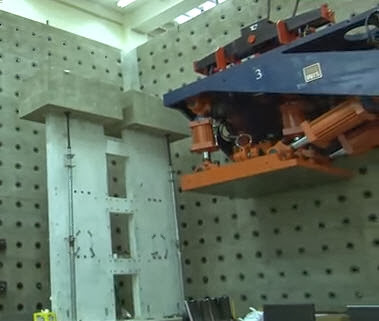
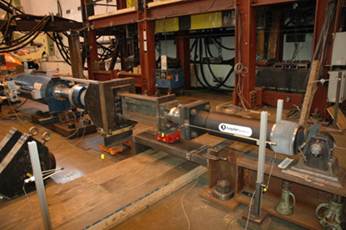
The primary objective of the NEES@Illinois facility is to create a physical-analytical simulation environment whereby multi-axial, full-scale structure-foundation-soil systems can be subjected to complex loading and boundary conditions representing earthquake ground motion. Actions and responses are captured by state-of-the-art instrumentation and are processed and visualized using software developed by the site.
The major physical components of the facility are the reaction structure and the loading and boundary condition boxes, or LBCBs. Each LBCB is a self-reacting assembly of actuators, swivel joints, and control software capable of imposing any combination of six actions (forces and moments) and six deformations (displacements and rotations) on specimens connected to the loading platforms of the LBCBs. The site has three (3) large LBCBs, which can be used separately or in combination. When used together the LBCBs can be controlled independently, or they can be controlled to act as a single LBCB with increased load capacity. One of the key attributes of the MUST-SIM facility is that the LBCBs may be reconfigured to accommodate a vast array of testing needs. Examples of past tests and specifications of the test equipment will be presented during the webinar.
In addition to the full-scale facility, the NEES@Illinois site has a fully-operational, 1/5th-scale version of the MUST-SIM laboratory. This facility provides a realistic pre-test environment and serves as an education and outreach facility, but has also proven to be a worthy research facility in its own right.
Beyond the hardware aspects of the laboratory, NEES@Illinois has also developed the control systems and data acquisition systems used in the MUST-SIM. These systems will be covered in detail.
Hybrid simulation offers the most realistic testing to mimic actual system responses and NEES@Illinois is at the forefront of this area of research. 3-D hybrid simulation using UI-SimCor, a simulation coordinator developed at NEES@Illinois, will also be discussed.
Sextos, A.G. (2013) “A Paperless Course on Structural Engineering Programming: investing in educational technology in the times of the Greek financial recession”, European Journal of Engineering Education.
This paper presents the structure of an undergraduate course entitled ‘programming techniques and the use of specialised software in structural engineering’ which is offered to the fifth (final) year students of the Civil Engineering Department of Aristotle University Thessaloniki in Greece. The aim of this course is to demonstrate the use of new information technologies in the field of structural engineering and to teach modern programming and finite element simulation techniques that the students can in turn apply in both research and everyday design of structures. The course also focuses on the physical interpretation of structural engineering problems, in a way that the students become familiar with the concept of computational tools without losing perspective from the engineering problem studied. For this purpose, a wide variety of structural engineering problems are studied in class, involving structural statics, dynamics, earthquake engineering, design of reinforced concrete and steel structures as well as data and information management. The main novelty of the course is that it is taught and examined solely in the computer laboratory ensuring that each student can accomplish the prescribed ‘hands-on’ training on a dedicated computer, strictly on a 1:1 student over hardware ratio. Significant effort has also been put so that modern educational techniques and tools are utilised to offer the course in an essentially paperless mode. This involves electronic educational material, video tutorials, student information in real time and exams given and assessed electronically through an ad hoc developed, personalised, electronic system. The positive feedback received from the students reveals that the concept of a paperless course is not only applicable in real academic conditions but is also a promising approach that significantly increases student productivity and engagement. The question, however, is whether such an investment in educational technology is indeed timely during economic recession, where the academic priorities are rapidly changing. In the light of this unfavourable and unstable financial environment, a critical overview of the strengths, the weaknesses, the opportunities and the threats of this effort is presented herein, hopefully contributing to the discussion on the future of higher education in the time of crisis.
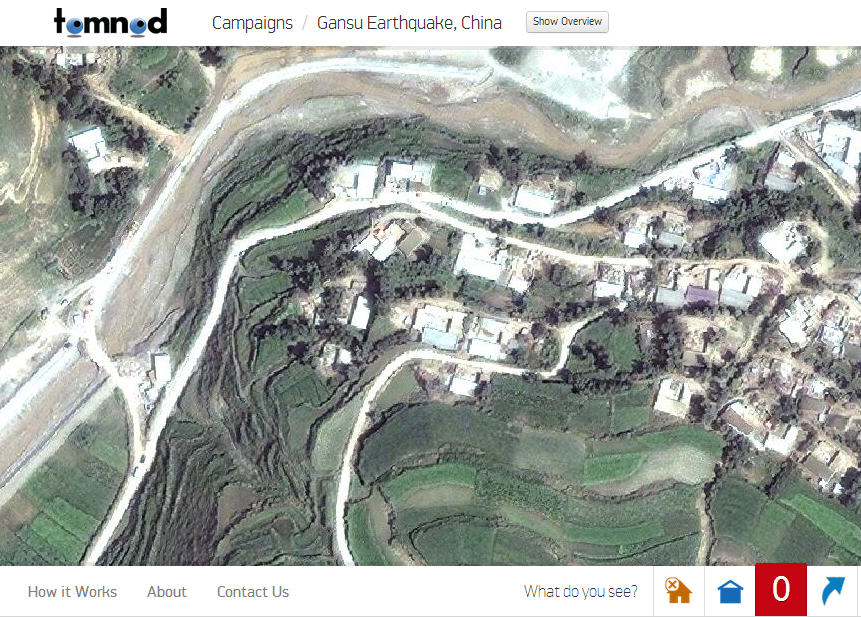
After the Christchurch earthquake, a new initiative has been undertaken to mobilize the engineering community to quickly trace damage visually based on high resolution Google Earth maps. This volunteer work helps the authorities identify quickly on the areas of highest earthquake impact and manage the recovery and reconnaissance activities. This time Tomnod, the web-based tool used for for this purpose has initiated a campaign to help identify the impact of the two powerful earthquakes that have struck China’s north-west Gansu province, killing at least 75 people and leaving more than 400 others injured.
In my opinion this initiative is quite premature so far while the subjectivity of the visualization by individual volunteers increases the uncertainty of the macroscopic assessment. However, the large number of the people involved may somehow smooth the assessment discrepancy and provide some basic trends regarding the areas most heavily hit, a fact that is of paramount importance particularly in extended remote areas such as the Chinese provinces. I think it is worth giving it a try by connecting to the digital images here. Even the idea of contributing to human relief from the comfort of your office or home is quite rewarding.
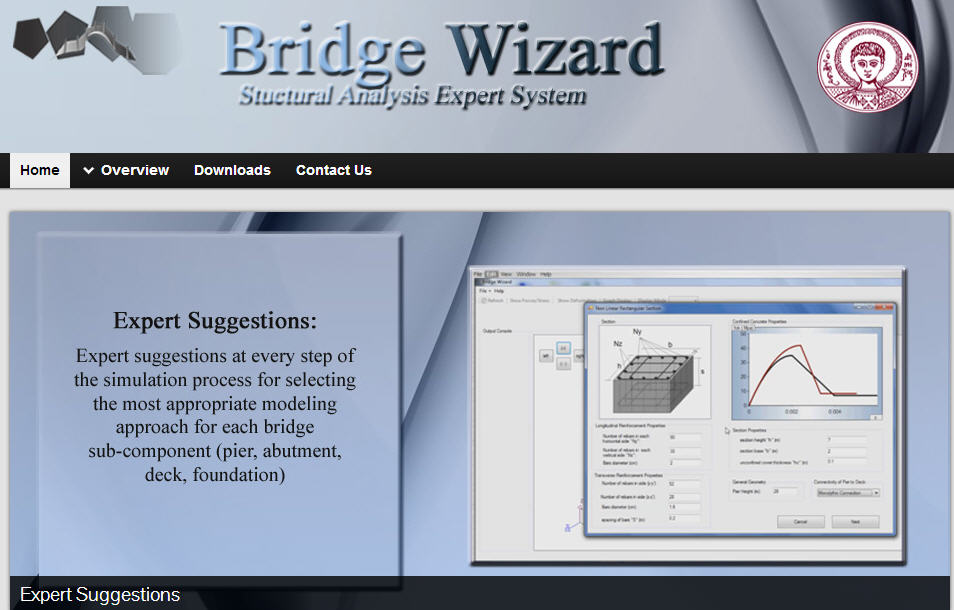
Bridge Wizard, is an interactive front-end software for the seismic analysis and assessment of bridge structures, that takes advantage of a sophisticated, Open-Source software for Earthquake Engineering Simulation (OpenSees) to provide: (a) conceptual assistance during the finite element analysis pre- and post-processing (b) finite element model development automations and (c) expert advice for modeling various bridge-specific issues that are key for the reliable prediction of structural response (such as boundary conditions, pier-deck connections, soil-structure interaction etc). Bridge Wizard improves the efficiency and credibility of the finite element modeling developed, particularly for the case of complex bridge structures and gives the designer more control in critical modeling decisions affecting the overall system response.
For all of the devastation caused by the 2011 earthquake/tsunami in Japan, the former, a 9.0 magnitude beast called “Tohoku,” could have claimed far more lives. The reason it didn’t? Since 2007, Japan has had an early warning system — conceived 10 years ago at Caltech — which California still hasn’t managed to set up. And while it only gives about a minute notice, it’s a minute Californians currently don’t have.
Until 2003, when Japanese seismologist Hiroo Kanamori and UC Berkeley’s Richard Allen published a study proving that early detection was possible, warning systems for earthquakes have relied on a concept that’s been around since the 19th century: detect the ground shaking at the fault line and send advanced notice to cities miles away through telegraphs, telephones, or modern telecommunications (depending on which century you’re in).
This system relies on the fact that electronic signals move much faster than seismic waves; For example, if you were in New York and on Twitter on August 23, 2011, you might have seen tweets from Washington DC about their earthquake just before the ground started shaking under your feet. As neat as that might have been (yay, new media!) retweeting is not a very good system for warning a city of impending seismic doom.
The new system put into place in Japan in 2007 detects earthquakes before they start shaking the Earth’s surface. Allen and Kanamori found that when tectonic plates shift, they release two forms of energy simultaneously, called p-waves and s-waves. S-waves cause all the damage on the surface. P-waves are harmless, but travel through the ground about twice as fast. So when Japan’s more than 1000 seismometers near their Pacific fault-line relayed p-wave data indicating a massive earthquake, the Japanese Meteorological Agency rang the alarm.
While this “early detection” still only gives about 60 seconds of warning, Japan was able to safely stop 11 500km/h bullet trains, disable 16,000 lifts, warn students to get under their desks and set off earthquake alarms across the country. Some 52 million Japanese received text alerts on their mobile phones. But that’s because Japan has the advanced warning system and a cultural awareness of the threat of earthquakes (for example, new iPhones bought in Japan come with quake-warning features built in).
California, on the other hand? Azeen Ghorayshi, in a great feature for the East Bay Express about Japan and California’s preparedness, says that California still has “next to nothing in terms of a public seismic warning system,” despite knowing how to build one for almost a decade and despite knowing the next “big one” is only matter of time. But building a statewide system is only a matter of politics and money, so it’ll probably be ready in no time. Meanwhile, here’s a $1 iPhone Seismometer app that you can make into your own DIY not-so-advanced warning system. [East Bay Express]
The
NEESR project entitled NEESR-CR: Performance-Based Design for
Cost-Effective Seismic Hazard Mitigation in New Buildings Using
Supplemental Passive Damper Systems (PI: Richard Sause) is currently
conducting a series of large-scale real-time hybrid simulations (RTHS)
on a 3-story steel frame building at the Real-time Multi-directional
(RTMD) Earthquake Simulation Facility, the Lehigh NEES Equipment Site.
The goal for this NEESR project is to develop
a validated, probabilistic, performance-based seismic designprocedure
for buildings with passive damping systems.The
RTHS data will be used to observe and understand the interactions of
the viscous dampers with the braces, beams, and columns of the
experimental substructure as well as the interactions
between the steel frame with the dampers and the rest of the building.
The project team has developed detailed analytical (numerical
simulation) models of the prototype building with nonlinear viscous
dampers, and the RTHS data will be used to validate the
models. RTHS
will take place February 21 – 22, 2013 between 1 and 4 pm EST. The RTHS
test matrix includes conducting a series of simulations using an
ensemble of 13 earthquake records at the design
basis earthquake (DBE) level. The RTHS can be viewed by telepresence,
where webcams and the Real-Time Data Viewer can be used to view video,
data and animation of the response of the building acquired from the
RTHS. To learn more or to remotely participate,
go to the following link (http://www.nees.lehigh.edu/rths-of-mrf-dbf-system-with-viscous-dampers). Result (including video) from completed tests will also be archived and
available at the previous link and through the Project Warehouse on NEES.org. Also, follow us on Facebook to get up to the minute simulation updates from our
research team.
The
project is a collaborative effort that includes California State
University, Northridge; California State Polytechnic University, Pomoma;
Lehigh University; The Pennsylvania State University,
Erie; and Tokyo Institute of Technology. Industry partners include
Corry Rubber Company, Taylor Devices, Miyamoto International, Inc. and
Simpson Gumpertz & Heger. More information about the above NEESR project can be found here. You are encouraged to visit the RTMD website to learn about the capabilities of the Lehigh NEES Equipment Site and completed and ongoing research projects. Data can be accessed at NEEShub for the completed projects.
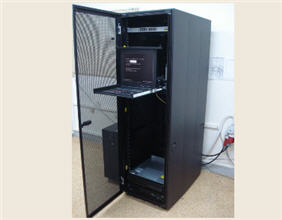
A new computational system has been setup at the Department of Civil Engineering of Aristotle University Thessaloniki, Greece and will officially kick-off operation on December 14th, 2012. The HCOUPER (High COmputational University PERformance) is an integrated
system, aiming to provide computational services to the members of the Department with research interests in running applications that are demanding in computational time, storage capacity and
memory usage. It is a multi-user environment running both Linux & Windows
OS by dynamically allocating computational resources where needed. More information may be found at: http://hcouper.weebly.com
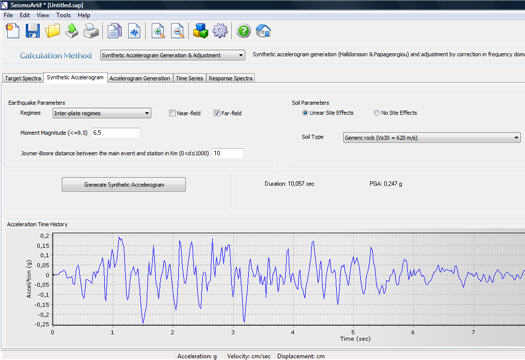
Seismosoft has announced the release of SeismoArtif, an application capable of generating artificial
earthquake accelerograms matched to a specific target response spectrum
using different calculation methods and varied assumptions. In other
words, the ideal companion tool of SeismoMatch, to be used in those cases where spectrum matching of real accelerograms is not pursuable.
In
tandem with this new release, Seismosoft has also published new versions of
SeismoSignal, SeismoSpect and SeismoMatch. In the News
section of the official website it is possible to get a glimpse of the novelties and
improvements introduced in these programs, which can all be downloaded
from here
.