Intercontinental Hybrid Experiment of a three span R/C bridge
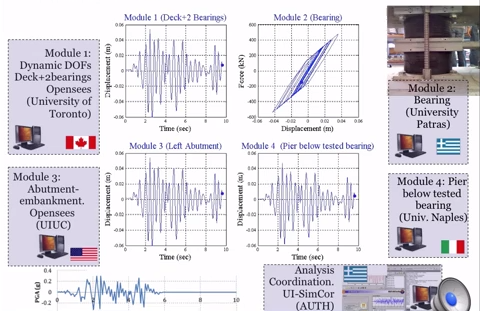
Hybrid test between Greece, Italy, Canada and United States.
Presentation made during the 10th National Conference on Earthquake Engineering, Anchorage, United States.
Video available:
Hybrid test between Greece, Italy, Canada and United States.
Presentation made during the 10th National Conference on Earthquake Engineering, Anchorage, United States.
Video available:
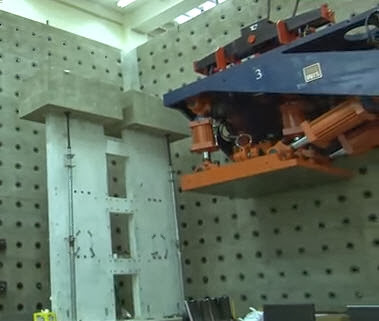
The primary objective of the NEES@Illinois facility is to create a physical-analytical simulation environment whereby multi-axial, full-scale structure-foundation-soil systems can be subjected to complex loading and boundary conditions representing earthquake ground motion. Actions and responses are captured by state-of-the-art instrumentation and are processed and visualized using software developed by the site.
The major physical components of the facility are the reaction structure and the loading and boundary condition boxes, or LBCBs. Each LBCB is a self-reacting assembly of actuators, swivel joints, and control software capable of imposing any combination of six actions (forces and moments) and six deformations (displacements and rotations) on specimens connected to the loading platforms of the LBCBs. The site has three (3) large LBCBs, which can be used separately or in combination. When used together the LBCBs can be controlled independently, or they can be controlled to act as a single LBCB with increased load capacity. One of the key attributes of the MUST-SIM facility is that the LBCBs may be reconfigured to accommodate a vast array of testing needs. Examples of past tests and specifications of the test equipment will be presented during the webinar.
In addition to the full-scale facility, the NEES@Illinois site has a fully-operational, 1/5th-scale version of the MUST-SIM laboratory. This facility provides a realistic pre-test environment and serves as an education and outreach facility, but has also proven to be a worthy research facility in its own right.
Beyond the hardware aspects of the laboratory, NEES@Illinois has also developed the control systems and data acquisition systems used in the MUST-SIM. These systems will be covered in detail.
Hybrid simulation offers the most realistic testing to mimic actual system responses and NEES@Illinois is at the forefront of this area of research. 3-D hybrid simulation using UI-SimCor, a simulation coordinator developed at NEES@Illinois, will also be discussed.
YouTube Channel: http://www.youtube.com/user/NEESATUIUC?feature=watch

The
NEESR project entitled NEESR-CR: Performance-Based Design for
Cost-Effective Seismic Hazard Mitigation in New Buildings Using
Supplemental Passive Damper Systems (PI: Richard Sause) is currently
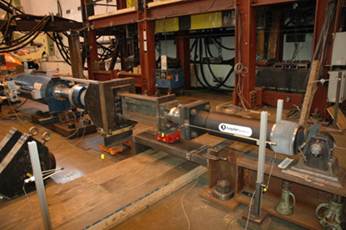
conducting a series of large-scale real-time hybrid simulations (RTHS)
on a 3-story steel frame building at the Real-time Multi-directional
(RTMD) Earthquake Simulation Facility, the Lehigh NEES Equipment Site.
The goal for this NEESR project is to develop
a validated, probabilistic, performance-based seismic design procedure
for buildings with passive damping systems.The
RTHS data will be used to observe and understand the interactions of
the viscous dampers with the braces, beams, and columns of the
experimental substructure as well as the interactions
between the steel frame with the dampers and the rest of the building.
The project team has developed detailed analytical (numerical
simulation) models of the prototype building with nonlinear viscous
dampers, and the RTHS data will be used to validate the
models. RTHS
will take place February 21 – 22, 2013 between 1 and 4 pm EST. The RTHS
test matrix includes conducting a series of simulations using an
ensemble of 13 earthquake records at the design
basis earthquake (DBE) level. The RTHS can be viewed by telepresence,
where webcams and the Real-Time Data Viewer can be used to view video,
data and animation of the response of the building acquired from the
RTHS. To learn more or to remotely participate,
go to the following link (http://www.nees.lehigh.edu/rths-of-mrf-dbf-system-with-viscous-dampers). Result (including video) from completed tests will also be archived and
available at the previous link and through the Project Warehouse on NEES.org. Also,
follow us on Facebook to get up to the minute simulation updates from our
research team.
The
project is a collaborative effort that includes California State
University, Northridge; California State Polytechnic University, Pomoma;
Lehigh University; The Pennsylvania State University,
Erie; and Tokyo Institute of Technology. Industry partners include
Corry Rubber Company, Taylor Devices, Miyamoto International, Inc. and
Simpson Gumpertz & Heger. More information about the above NEESR project can be found
here. You are encouraged to visit the
RTMD website to learn about the capabilities of the Lehigh NEES Equipment Site and completed and
ongoing research projects. Data can be accessed at NEEShub for the
completed projects.


The NEES site at the University of California, Berkeley (UC Berkeley) will host the annual Hybrid Simulation Workshop June 28 and 29, 2012, at its Richmond Field Station.
Limited
travel support is available for graduate students, post-doctoral
researchers, or tenure-track faculty at US schools. Please register and
apply for travel support using the online registration form at the Hybrid Simulation Workshop web page.
To observe the testing live, please follow this telepresence link http://nees.unr.edu/projects/4span.html at 10:00 am PDT on Tuesday June 15th. Data will be streamed through RDV.
Τοίχοι πλήρωσης χρησιμοποιούνται συχνά ως εσωτερικά ή εξωτερικά χωρίσματα σε πλαίσια από οπλισμένο σκυρόδεμα. Η επίδραση της τοιχοποιίας στη σεισμική συμπεριφορά τέτοιων κατασκευών παραμένει αναπάντητο ερώτημα καθώς ο ρόλος της τοιχοποιίας στο μηχανισμό αντίστασης στα σεισμικά φορτία δεν είναι πλήρως κατανοητός εξ αιτίας της αλληλεπίδρασης μεταξύ της τοιχοποιίας και του περιβάλλοντος πλαισίου. Η εκτίμηση αυτού του ρόλου είναι μια πρόκληση για τους μηχανικούς εξ αιτίας της ποικιλίας και της πολυπλοκότητας των μηχανισμών αστοχίας και της έλλειψης αξιόπιστων μεθόδων προσομοίωσης αυτών των μηχανισμών. Επιπροσθέτως, υπάρχει έλλειψη πειραματικών δεδομένων από δυναμικά πειράματα πολυωρόφων κατασκευών αυτής της κατηγορίας σε μεγάλη κλίμακα.
Η παρουσίαση αυτή εξετάζει αυτό το πρόβλημα με εκτεταμένη αναλυτική και πειραματική μελέτη. Το πειραματικό πρόγραμμα περιλαμβάνει ψευδοστατικά πειράματα πλαισίων μικρής και μεγάλης κλίμακας με και χωρίς ανοίγματα, καθώς επίσης και πειράματα σε σεισμική τράπεζα ενός τριώροφου πλαισίου δυο φατνωμάτων. Το πλαίσιο, το οποίο ήταν σχεδιασμένο σύμφωνα με τη μέθοδο σχεδιασμού του 1920 είναι η μεγαλύτερη κατασκευή αυτού του τύπου που έχει δοκιμαστεί σε σεισμική τράπεζα. Ο σχεδιασμός των πλαισίων, οι πειραματικές διατάξεις και μέθοδοι, καθώς και τα αποτελέσματα των πειραμάτων περιλαμβάνονται στην παρουσίαση.
Τα πειραματικά δεδομένα έχουν χρησιμοποιηθεί για την αξιολόγηση των προτεινόμενων αναλυτικών μεθόδων προσομοίωσης. Οι μέθοδοι αυτές περιλαμβάνουν μια μεθοδολογία με χρήση μη-γραμμικών πεπερασμένων στοιχείων και ένα απλοποιημένο αναλυτικό εργαλείο. Αξιολογημένα μοντέλα έχουν χρησιμοποιηθεί σε παραμετρικές αναλύσεις για τον εντοπισμό των κρίσιμων ιδιοτήτων των υλικών με τη μεγαλύτερη επιρροή στα αριθμητικά αποτελέσματα. Η παρουσίαση περιλαμβάνει και προκαταρκτικά αποτελέσματα από σειρά πειραμάτων σε ένα δεύτερο πλαίσιο επί του οποίου εφαρμόστηκαν δυο μέθοδοι ενίσχυσης της τοιχοποιίας.
Ανδρέας Σταυρίδης
Δρ. Πολιτικός Μηχανικός
Μεταδιδακτορικός Ερευνητής
University of California, San Diego