International Workshop on “Resilience of Natural Gas Pipeline Networks to Natural Hazards” to be organized at the University of Bristol on 1st September 2016 in the framework of the Exchange-Risk, H2020 EU research project. Panels will be
held on pipeline inspection and monitoring, integrity and fragility,
soil-pipe interaction, asynchronous ground motion, hybrid testing, risk
and network resilience.
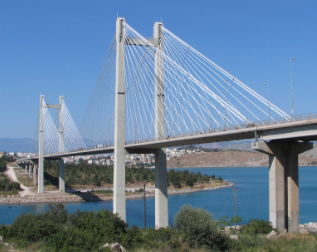
The 395m long Evripos bridge in central Greece, connects the island of Evia to the mainland. An accelerometer array of 43 triaxial sensors has been monitoring both the free-field excitation and the response of the superstructure in a series of seismic events since 1994. This paper focuses on the characteristics of the spatially variable, earthquake ground motions recorded during two seismic events (1999 & 2013) and the corresponding bridge response. A model updating is performed to match the numerically predicted with the measured bridge response. Then, the nature of the recorded ground motions is studied and the incoherency patterns of the seismic waves are compared with empirical or semi-empirical models. It is observed that the loss of coherency at the site is isotropic. It is also documented, for the first time based on actual free-field and on-structure recordings, that the asynchronous excitation of a bridge excited higher modes of vibration while suppressing the oscillation on its fundamental frequency. The latter is in line with analytical predictions and is believed to be a key finding in understanding the nature of spatially variable earthquake ground motion and predicting its potential impact on the seismic response of bridges.
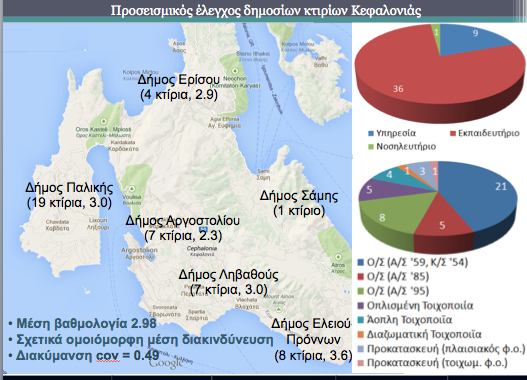
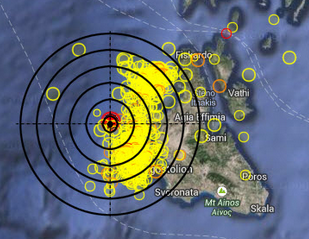
Presentation made during the Workshop about Cephalonia Earthquake jointly organised by the Society of Civil Engineers, the Hellenic Association for Earthquake Engineering, the Greek branch of the International Association for Bridge and Structural Engineering and the Organisation for Earthquake Protection and Planning.
The European Center of Prevention and Forecasting of Earthquakes(ECPFE) and the Earthquake Planning and Protection Organization (EPPO) of Greece took the initiative to organize in the framework of the EUR-OPA agreement a Workshop-Seminar on the above subject. The Workshop-Seminar will take place in Athens, 2 December 2013. A field trip will take place on 3 December 2013. The thematic topics of the Workshop-Seminar are :
1.Classification of importance of Monuments and acceptable damage levels 2.Basic data influencing the design (Architectural , historical and Structural documentation, Monitoring of seismic behaviour, etc 3.Methods of Analysis for Assessment of bearing capacity and the design of Structural Interventions, 4.Estimation of Resistances of critical regions before and after Interventions, 5.Selection of Design Seismic Actions for the redesign, 6.Criteria for the selection of the most appropriate scheme of Structural Interventions: Monumentic values/optimum interventions 7.Case studies 8.Existing National Regulatory documents for the aseismic design of structural interventions in Monuments
Please note that the official language of the Workshop-Seminar is in English.
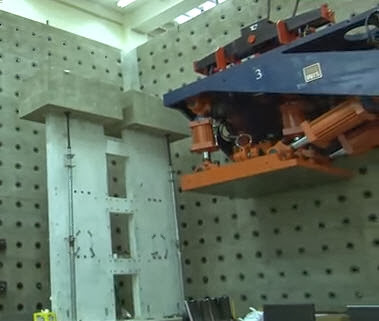
The primary objective of the NEES@Illinois facility is to create a physical-analytical simulation environment whereby multi-axial, full-scale structure-foundation-soil systems can be subjected to complex loading and boundary conditions representing earthquake ground motion. Actions and responses are captured by state-of-the-art instrumentation and are processed and visualized using software developed by the site.
The major physical components of the facility are the reaction structure and the loading and boundary condition boxes, or LBCBs. Each LBCB is a self-reacting assembly of actuators, swivel joints, and control software capable of imposing any combination of six actions (forces and moments) and six deformations (displacements and rotations) on specimens connected to the loading platforms of the LBCBs. The site has three (3) large LBCBs, which can be used separately or in combination. When used together the LBCBs can be controlled independently, or they can be controlled to act as a single LBCB with increased load capacity. One of the key attributes of the MUST-SIM facility is that the LBCBs may be reconfigured to accommodate a vast array of testing needs. Examples of past tests and specifications of the test equipment will be presented during the webinar.
In addition to the full-scale facility, the NEES@Illinois site has a fully-operational, 1/5th-scale version of the MUST-SIM laboratory. This facility provides a realistic pre-test environment and serves as an education and outreach facility, but has also proven to be a worthy research facility in its own right.
Beyond the hardware aspects of the laboratory, NEES@Illinois has also developed the control systems and data acquisition systems used in the MUST-SIM. These systems will be covered in detail.
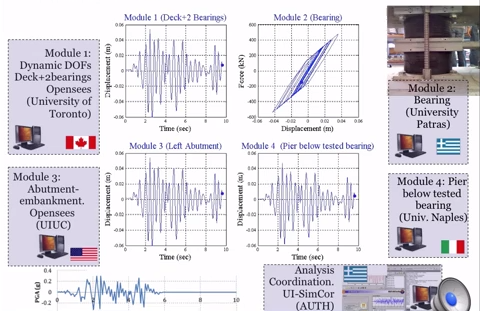
Hybrid simulation offers the most realistic testing to mimic actual system responses and NEES@Illinois is at the forefront of this area of research. 3-D hybrid simulation using UI-SimCor, a simulation coordinator developed at NEES@Illinois, will also be discussed.
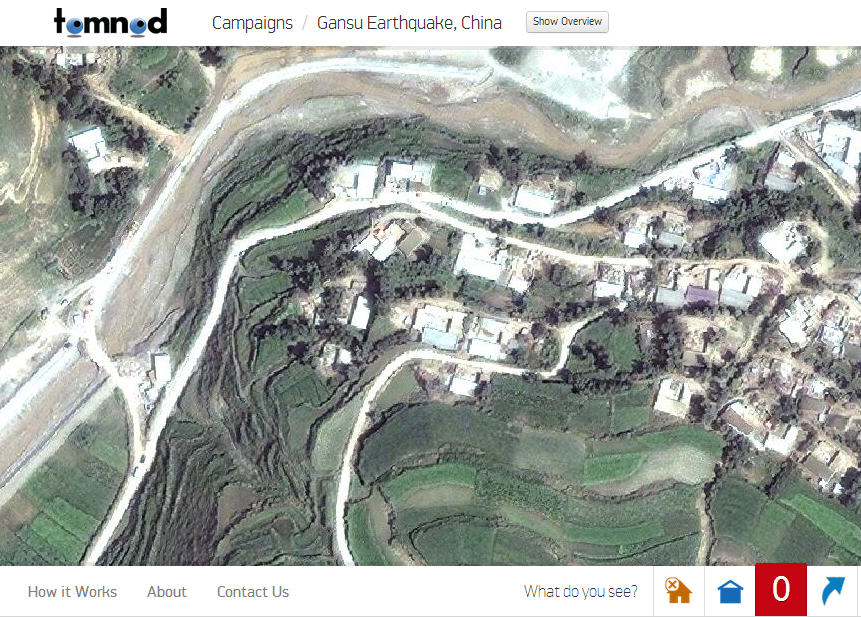
After the Christchurch earthquake, a new initiative has been undertaken to mobilize the engineering community to quickly trace damage visually based on high resolution Google Earth maps. This volunteer work helps the authorities identify quickly on the areas of highest earthquake impact and manage the recovery and reconnaissance activities. This time Tomnod, the web-based tool used for for this purpose has initiated a campaign to help identify the impact of the two powerful earthquakes that have struck China’s north-west Gansu province, killing at least 75 people and leaving more than 400 others injured.
In my opinion this initiative is quite premature so far while the subjectivity of the visualization by individual volunteers increases the uncertainty of the macroscopic assessment. However, the large number of the people involved may somehow smooth the assessment discrepancy and provide some basic trends regarding the areas most heavily hit, a fact that is of paramount importance particularly in extended remote areas such as the Chinese provinces. I think it is worth giving it a try by connecting to the digital images here. Even the idea of contributing to human relief from the comfort of your office or home is quite rewarding.
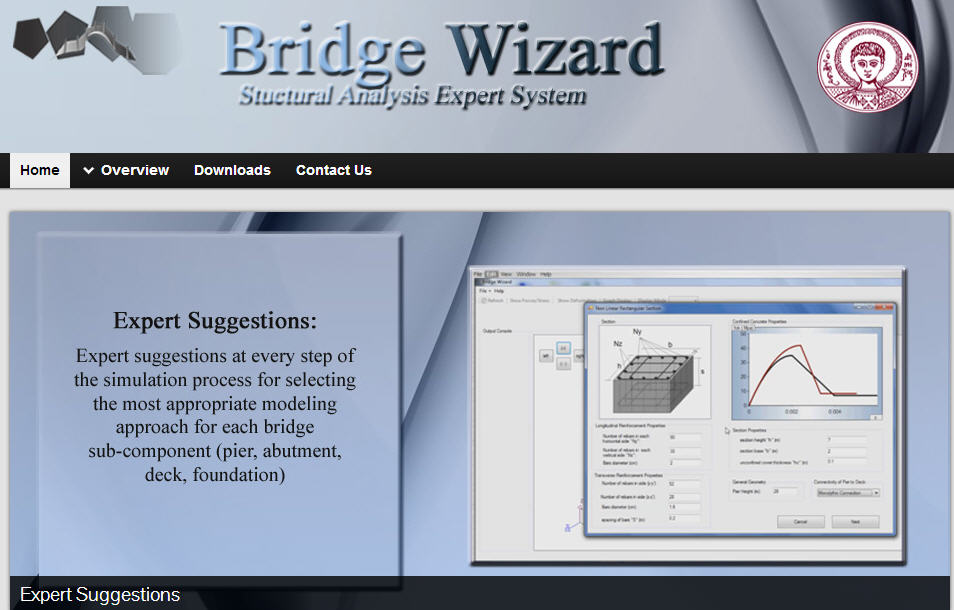
Bridge Wizard, is an interactive front-end software for the seismic analysis and assessment of bridge structures, that takes advantage of a sophisticated, Open-Source software for Earthquake Engineering Simulation (OpenSees) to provide: (a) conceptual assistance during the finite element analysis pre- and post-processing (b) finite element model development automations and (c) expert advice for modeling various bridge-specific issues that are key for the reliable prediction of structural response (such as boundary conditions, pier-deck connections, soil-structure interaction etc). Bridge Wizard improves the efficiency and credibility of the finite element modeling developed, particularly for the case of complex bridge structures and gives the designer more control in critical modeling decisions affecting the overall system response.
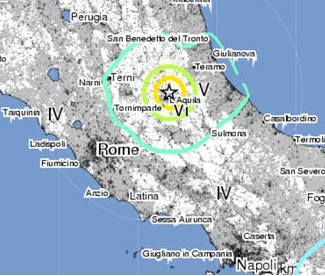
PRESS RELEASE ============= It is with
great regret that we have been informed about the primary conviction of
seven Italian scientists, considered responsible for the loss of human life
during the recent earthquake in L’Aquila. With deepest respect for each and
every human life lost due to this natural disaster, the Hellenic Society for Earthquake Engineering, would like to note the following:
– It is
commonly accepted within the scientific community worldwide, that there cannot
be a short-term prediction of earthquakes, nor can it be an accurate
determination of the space, time and intensity of a future seismic event. For
this reason, it is practically impossible to take any essential precaution
measures for the protection of citizens in an area that is sufficiently narrow
and within a reasonably short period of time. Citizens and the State ought to
know the limits of scientific knowledge and to accept the large uncertainties
associated with the prediction of seismic activity, which is unfortunately
still impossible to overcome. From a scientific point of view and in accordance
with all international guidelines and state-of-practice, the Italian colleagues
acted as any other scientist would have in a similar position.
– The
criminalization of the inherent scientific inability to exceed the current
state of knowledge, is not only unjust for the persons in charge of the Italian
National Commission for the Forecast and Prevention of Major Risks, who have
contributed at a great extent in the mitigation of seismic risk. It is expected
to inactivate all relevant Civil Protection Departments in Italy and worldwide,
which will be reluctant to act in the future based on actual data. This phobic
crisis management may also result into a seriously misleading assessment of the
probabilistic nature of seismic hazard. This fact alone may have severe
consequences on the economic and social life of all regions exposed to seismic
risk internationally. Most importantly, it raises serious questions regarding
the way in which the State and society view the scientific progress as a whole.
Based on
the above, we would like to express the full and unreserved support of the
Hellenic Department of Earthquake Engineering to the convicted colleagues. We
do hope that the Italian Authorities will beneficially assess the validity of
our allegations.
Prof.
Kyriazis Pitilakis
Chairman
of the HSEE
Assist. Prof. Anastasios Sextos
Secretary of HSEE
HELLENICSOCIETY for EARTHQUAKEENGINEERING [ HSEE ]