Bridge Wizard: a freeware for Seismic Analysis of Bridges using OpenSees
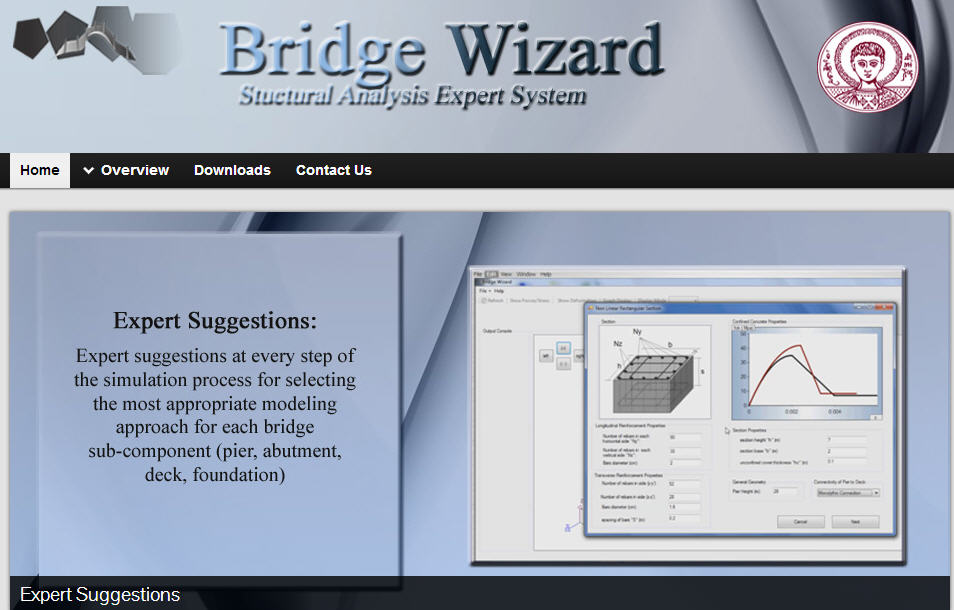
Bridge Wizard, is an interactive front-end software for the seismic analysis and assessment of bridge structures, that takes advantage of a sophisticated, Open-Source software for Earthquake Engineering Simulation (OpenSees) to provide: (a) conceptual assistance during the finite element analysis pre- and post-processing (b) finite element model development automations and (c) expert advice for modeling various bridge-specific issues that are key for the reliable prediction of structural response (such as boundary conditions, pier-deck connections, soil-structure interaction etc). Bridge Wizard improves the efficiency and credibility of the finite element modeling developed, particularly for the case of complex bridge structures and gives the designer more control in critical modeling decisions affecting the overall system response.
Software website: www.bridge-wizard.eu
Probabilistic Seismic Hazard Assessment through geometrically non-linear back-analysis of Byzantine and Roman Monuments
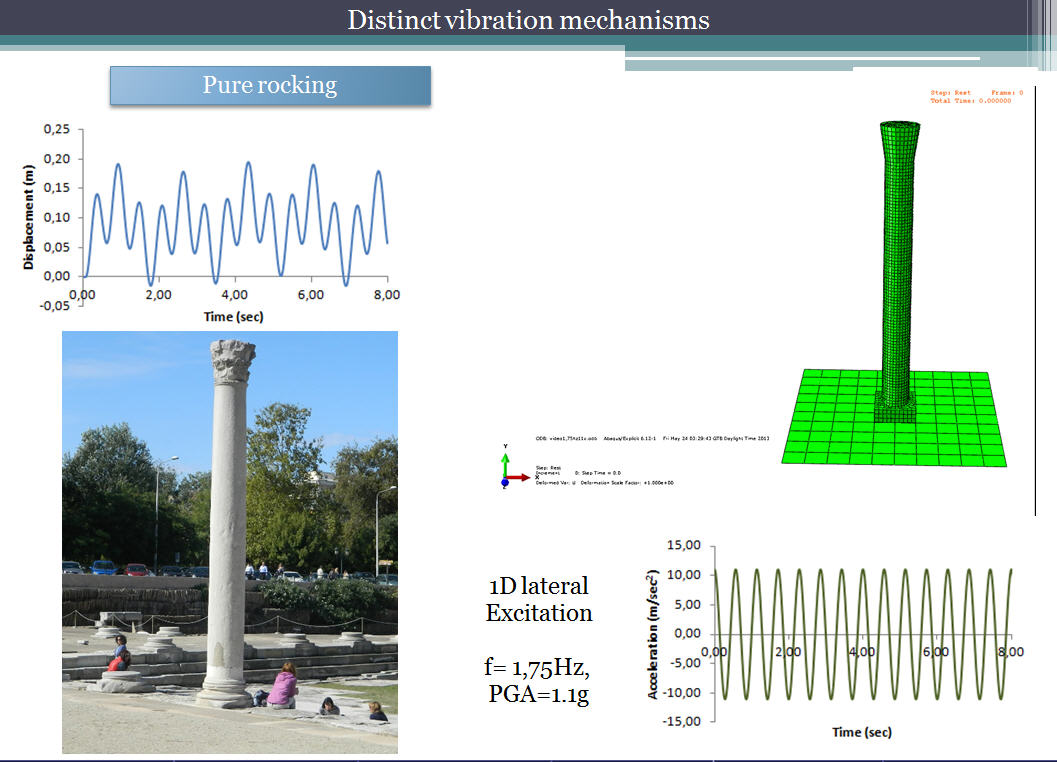
This paper aims at developing the tools and strategy for assessing the seismic performance of the Byzantine and Roman remains in the city of Thessaloniki, in Greece, as a means to back-evaluate and enrich the seismic microzonation studies available for the Metropololitan area. At first, focus is made on the Walls that have been constructed at the end of the 4th century A.D. in the reign of Theodosius the Great and numerous blocks remain intact widespread within the city grid. The study particularly focuses on a specific Wall residuum, whose small dimensions, simple morpholgy (free-standing, rocking dominated masonry block), availability of nearby strong ground motion recordings and good knowledge of the underlying soil conditions, constitute a well-controlled case-study with the minimum possible numerical modeling (i.e., epistemic), record-to-record and material uncertainty. Secondly, the study focuses on an ancient Roman column, which was reestablished in 1969 after extensive archeological works. For both historical structures, a refined probabilistic dynamic analysis approach is adopted and the structural performance is examined, through a Monte Carlo Simulation scheme, for a number of realistic earthquake scenarios, accounting for geometric nonlinearities (i.e., sliding and rocking) and uncertainties in friction properties. Given the absence of damage, permanent displacement or collapse of the particular bodies, the probability of non-exceedance of a specific intensity measures (for the period that the structures remain intact) is assessed for the Wall residuum and the ancient colonnade, thus implicitly, for the city as a whole. It is also demonstrated that the fragility predicted without dully considering rocking and sliding of the two rigid blocks may lead to misleading results for particular sets of strong ground motions.
Sextos AG, Nalmpantis S, Faraonis P, et al. (2013) Probabilistic seismic hazard assessment through geometrically non-linear back-analysis of Byzantine and Roman Monuments. 10th HSTAM International Congress on Mechanics. Chania, Crete, Greece.
Seventh National Seismic Conference on Bridges and Highways (7nsc)
“Bridge Resilience for Earthquakes and Other Natural Hazards”. Oakland May 20-22, 2013.
The Seventh National Seismic Conference on Bridges & Highways is tailored to the needs of engineers working for state and local departments of transportation, design consultants, contractors, researchers, mangers, and others responsible for transportation facilities. International guests will be able to dialogue with others, share their successes and needs, and learn the latest approaches to design, retrofitting, geotechnology, inspection etc.
Seismic Strengthening of Hospitals
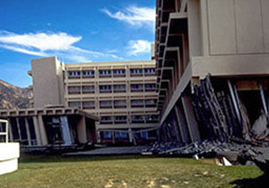
By NISEE
Hospital reconstruction and seismic strengthening provided continuous demand for construction design and engineering services in recent years. (See NISEE, Dec 9, 2011) In California, compliance with mandatory seismic performance objectives for critical health care facilities is largely supervised through the California Office of Statewide Planning and Development (OSPD). A hospital’s ability to function adequately after a large earthquake is dependent on the building’s structural components (a building’s primary load carrying system of foundation, columns, beams, floors, walls and roof), non-structural components (building elements such as ceilings, partitions, pipes, mechanical and electrical, that are not part of the structural load-bearing system), occupants (staff and patients) and contents (equipment, supplies, furnishings, etc.) remaining largely undamaged. Hospital serviceability after natural disaster relies on robust interconnectedness of lifeline systems (water, power, transportation, etc.) that support hospital services. The constitution of structural, non-structural and contents may provide unique seismic strengthening challenges for hospitals.
For seismic strengthening of modern hospital buildings, reliable site-specific loss estimation techniques (e.g.: Blume-157) can account for structural and non-structural damage. Engineering building codes (e.g.:ICBO, FEMA, California Building Codes), applied research programs (e.g.: ATC-58, MCEER, Japan E-Defense) and sophisticated testing methodologies to analyze and strengthen structural and many non-structural systems to resist moderate to strong earthquake shaking or geotechnical damage are reasonably advanced. Video of recent shake-table testing at the University of California, San Diego (‘Building it Better: Earthquake-Resilient Hospitals for the Future’) confirms some ability to achieve both structural and non-structural hospital resilience after credible earthquakes in California.
Read more / Original Source




Earthquake Photo Galleries by EERI
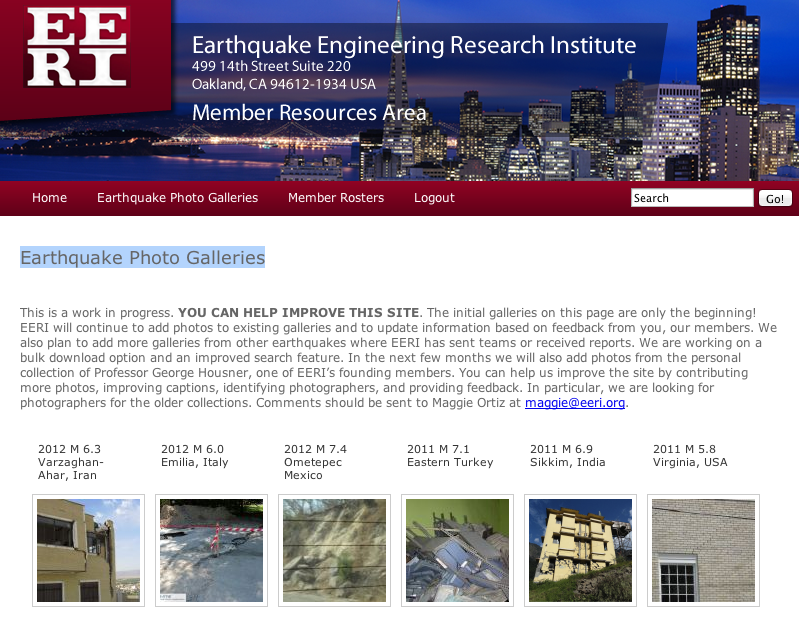
EERI is launching a fantastic new resource for members only–online photo galleries from many recent and important earthquakes. Included are galleries for over 30 earthquakes. Each gallery features from 30 to 300 images and all photos are searchable by keyword. These initial galleries are only the beginning! EERI will continue to add new galleries and is working on a bulk download option and an improved search feature. In the next few months we will also add photos from the personal collection of Professor George Housner, one of EERI’s founding members. You can help us improve the site by contributing more photos, improving captions, identifying photographers, and providing feedback. Any comments should be sent to Chris Lee at Chris@eeri.org.
Preservation of Byzantine Antiquities at the Venizelou Metro Station, Thessaloniki
Official proposal of the Department of Civil Engineering regarding the preservation of Byzantine antiquities at the Venizelou Metro station, in Thessaloniki, Greece. Powerpoint presentation and Video illustration of the concept as presented during the Workshop organized by Aristotle University Thessaloniki on April 19th, 2013.
All four alternative solutions
Streaming of the Workshop
Α
ISSARS: New freeware for structure-specific ground motion selection
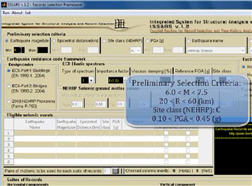 Current practice enables the design and assessment of structures in earthquake prone areas by performing time history analysis with the use of appropriately selected strong ground motions. This study presents a Matlab-based software environment, which is integrated with a finite element analysis package, and aims to improve the efficiency of earthquake ground motion selection by accounting for the variability of critical structural response quantities. This additional selection criterion, which is tailored to the specific structure studied, leads to more reliable estimates of the mean structural response quantities used in design, while fulfils the criteria already prescribed by the European and US seismic codes and guidelines. To demonstrate the applicability of the software environment developed, an existing irregular, multi-storey, reinforced concrete building is studied for a wide range of seismic scenarios. The results highlight the applicability of the software developed and the benefits of applying a structure-specific criterion in the process of selecting suites of earthquake motions for the seismic design and assessment.
Software, Video tutorials and Manuals available at: http://www.asextos.net/issars.html
Related Publication: Katsanos, E. and Sextos. A.G. (2013) “ISSARS: An integrated software environment for structure-specific earthquake ground motion selection”, Advances in Engineering Software, 58, 70-85.
Mini-Symposium on Computer-Aided Seismic Design and Assessment of Bridges
The 2013 International Conference on Earthquakes and Structures (ICEAS13) (http://asem.cti3.com/ICEAS.
As part of ICEAS13, a Mini-Symposium on “Computer-Aided Seismic Design and Assessment of Bridges” is being organized by Anastasios Sextos (Assistant Professor at Aristotle University of Thessaloniki).
The Mini-Symposium focuses on new computational methods for the seismic design and assessment of bridge structures primarily, but not exclusively, dealing with selection and scaling of ground motion, abutment-embankment and soil-foundation-superstructure interaction, seismic isolation, inelastic structural response, seismic pounding, structural health monitoring and control.
Authors interested in this Mini-Symposium are requested to submit a 300 words abstract by 31 March 2013. through the link http://www.techno-press.org/
The procedure is to select “Abstract Submission – ASEM13” and, subsequently, the “Computer-Aided Seismic Design and Assessment of Bridges” Mini Symposium. Deadline for submitting the full conference paper after the acceptance of the abstract is 31 May 2013.
It would be preferable to notify the organizer of the Mini-Symposium at (asextos@civil.auth.gr) along with the submission of abstract.
Thank you in advance for your kind attention and we are looking forward for an interesting session.
More info: http://asem.cti3.com/ICEAS.htm