Probabilistic Seismic Hazard Assessment through geometrically non-linear back-analysis of Byzantine and Roman Monuments
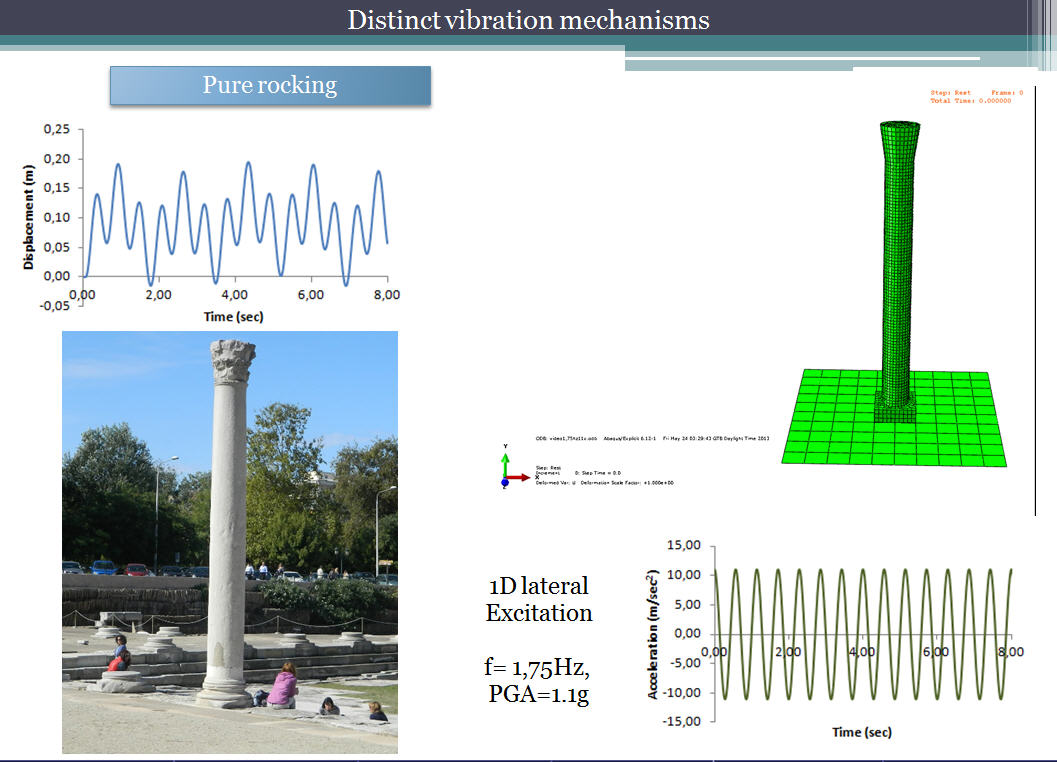
This paper aims at developing the tools and strategy for assessing the seismic performance of the Byzantine and Roman remains in the city of Thessaloniki, in Greece, as a means to back-evaluate and enrich the seismic microzonation studies available for the Metropololitan area. At first, focus is made on the Walls that have been constructed at the end of the 4th century A.D. in the reign of Theodosius the Great and numerous blocks remain intact widespread within the city grid. The study particularly focuses on a specific Wall residuum, whose small dimensions, simple morpholgy (free-standing, rocking dominated masonry block), availability of nearby strong ground motion recordings and good knowledge of the underlying soil conditions, constitute a well-controlled case-study with the minimum possible numerical modeling (i.e., epistemic), record-to-record and material uncertainty. Secondly, the study focuses on an ancient Roman column, which was reestablished in 1969 after extensive archeological works. For both historical structures, a refined probabilistic dynamic analysis approach is adopted and the structural performance is examined, through a Monte Carlo Simulation scheme, for a number of realistic earthquake scenarios, accounting for geometric nonlinearities (i.e., sliding and rocking) and uncertainties in friction properties. Given the absence of damage, permanent displacement or collapse of the particular bodies, the probability of non-exceedance of a specific intensity measures (for the period that the structures remain intact) is assessed for the Wall residuum and the ancient colonnade, thus implicitly, for the city as a whole. It is also demonstrated that the fragility predicted without dully considering rocking and sliding of the two rigid blocks may lead to misleading results for particular sets of strong ground motions.
Sextos AG, Nalmpantis S, Faraonis P, et al. (2013) Probabilistic seismic hazard assessment through geometrically non-linear back-analysis of Byzantine and Roman Monuments. 10th HSTAM International Congress on Mechanics. Chania, Crete, Greece.