NEEShub Release 4.0

The NEEScomm IT Team announced Release 4.0, a major NEEShub
Release.  Release enhancements are related to the Project Warehouse, Project Reviews, Data Status Report Generation, Digital Object Identifiers and Project Warehouse and Project Editor support for Simulation and Hybrid Simulation Experiments. They are described in detail in http://nees.org/announcements/neeshubrelease40

Web-based statics course

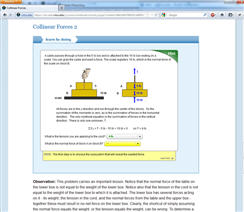
OLI Engineering Statics
is a freely available, on-line Statics course coauthored by Anna Dollár
and Paul Steif. The course is part of a suite of cognitively informed,
web-based introductory level undergraduate courses that were developed
at Carnegie Mellon University under the Open Learning Initiative.
The initial development of this course was supported by the William
and Flora Hewlett Foundation. Further development of the OLI Engineering
Statics course has been supported by the National Science Foundation
under grant DUE 0918271.

The OLI Engineering Statics course contains many interactive
elements, including: simulations, “walk-throughs” that integrate voice
and graphics to explain an example of the procedure or a difficult
concept, and, most prominently, computer tutors in which students
practice problem solving, with hints and feedback. The course is built
around a series of carefully devised learning objectives that are
independently assessable.While individual learners can and do use OLI Engineering Statics, it
is also increasingly used in Statics courses led by instructors. In
different settings it: replaces the textbook, acts as a supplement to
the textbook, or functions as the primary instruction in a
instructor-led, distance course. When a group of students enter OLI
Engineering Statics using an instructor-generated course key, then the
instructor has full access to those students’ activities in the course,
including graded quizzes, and can leverage that knowledge to improve
classroom instruction. Information about the Open Learning Initiative generally may be found here. The Open and Free version of the OLI Engineering Statics may be found here.

Information for instructors who are interested in setting up an
academic section of OLI Engineering Statics for their students and
blending OLI into their class may be found here.

Enhanced by Zemanta

OpenSees Days 2012

PEER and NEES will host OpenSees Days 2012 on August 15-16 at the
Richmond Field Station, an off-campus facility of the University of
California, Berkeley
.  Students, researchers, and practitioners are
welcome to attend any of the days.

Wednesday, August 15: Getting Started With OpenSees
The annual one-day training workshop on how to use OpenSees will be
more hands-on this year. This workshop is intended for beginning users.
This workshop will introduce users to the tcl scripting language, and
basic modeling and analysis techniques using OpenSees.

Thursday, August 16: OpenSees: Beyond the Basics

Seal of the University of California, Berkeley
Seal of the University of California, Berkeley (Photo credit: Wikipedia)

This workshop is intended for intermediate users and those who have
attended the Getting Started Workshop. The workshop will focus on
structural and geotechnical modeling using OpenSees, and how to extend
OpenSees for your own research needs.  The afternoon sessions will be
devoted to presentations from industry and research representatives who
will discuss how OpenSees has been used and extended to further their
work.

**Anyone from industry or academia interested in presenting on August 16th is encouraged to send a short abstract to Frank McKenna before July 1, 2012.**

The event is free, but registration is required because space is
limited to the first 100 applicants.  Registration closes on August 10,
2012.

Registration and additional program information can be found the OpenSees Days 2012 website.

Enhanced by Zemanta

Earthquakes and Megacities: A Free Webinar on Thursday, May 31

A
one-hour live-streaming webinar on the topic of Earthquakes and
Megacities will take place Thursday, May 31, 2012, at 8:00 a.m. PDT. To
access the webinar, visit http://wms.fccn.pt/15wcee.*


Speakers:

The Organizing Committee of the 15th World Conference on Earthquake Engineering (15WCEE) is hosting the webinar.

*MAC users: Install Flip4Mac plugin
*Mozilla Firefox users: Install Media Player Firefox plugin

Earthquake in northern Italy

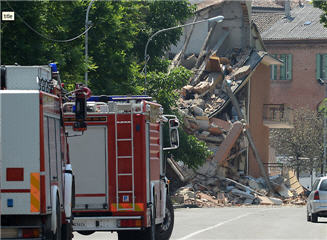
MIRANDOLA, Italy (AP) — A powerful earthquake killed at least 15 people
as it rocked a swath of northern Italy on Tuesday. Factories and
churches collapsed, dealing another blow to a region where thousands are still homeless after a stronger quake just nine days ago.
The 5.8 magnitude quake added to the misery being felt in the Emilia
Romagna region of towns north of Bologna, one of Italy’s most
agriculturally and industrial protective areas.
The quake hit just after 9:00 a.m. with an epicenter 40 kilometers (25
miles) northwest of Bologna, according to the U.S. Geological Survey —
just a handful of (miles) kilometers away from where the deadly May 20
quake was centered.
The quake was felt from Piedmont in northwestern Italy to Venice in the
northeast and as far north as Austria. It was followed by many
aftershocks, some registering more than 5.0 in magnitude.

Hybrid Simulation Workshop at NEES@Berkeley – June 28 & 29

The NEES site at the University of California, Berkeley (UC Berkeley) will host the annual Hybrid Simulation Workshop June 28 and 29, 2012, at its Richmond Field Station.

This
year’s Hybrid Simulation Workshop emphasizes real-time loading,
including demonstrations of our new “smart” dynamic platform. Attendees
will:
·         Learn the basics of hybrid simulation methods
·         Learn about the basic tools OpenSees and OpenFresco
·         Conduct several real-time hybrid simulation demonstrations at the NEES@Berkeley equipment site
·         Be able to use hybrid simulation in your NEES and non-NEES projects
·         Prepare to develop new hybrid simulation tests and algorithms
·         Learn
about pros and cons (accuracy, limits, ease of use, field applications
in damage assessment) of modern non-conventional monitoring and
measuring techniques.


The registration deadline is June 15.  This workshop is offered at no cost to participants.

Limited
travel support is available for graduate students, post-doctoral
researchers, or tenure-track faculty at US schools.  Please register and
apply for travel support using the online registration form at the  Hybrid Simulation Workshop web page.

Discovering OpenSees: Surfing the Waves of OpenSees

“Parallel & Grid Computing” on May 31 & June 1

The next seminar in the web-based Discovering OpenSees: Surfing the waves of OpenSees
learning series will occur on May 31 and June 1. The session will be
broadcast twice at times that will allow users in all time zones around
the world to participate. This 1-hour session is titled “Parallel &
Grid Computing” and will occur on May 31 at 4:00 pm Pacific Time &
on June 1 at 10:00 am Pacific Time.


This seminar will provide a brief introduction to Parallel and Grid
Computing with OpenSees using the resources made available to users
through NEEShub.

This seminar covers:

  • Introduction to Parallel & Grid Computing
  • Parallel Computing With OpenSees
  • Running Parallel Examples on NEEShub
  • Grid Computing Using Pegasus, the Open Science Grid and OpenSees
  • Q&A with web participants

How can I join the seminar?
Register for the seminar on May 31 at 4:00 pm Pacific Time
Register for the seminar on June 1 at 10:00 am Pacific Time

Once registered, you will receive a confirmation email with instructions
for joining the meeting. More information will be posted at the Discovering OpenSees Wiki page.

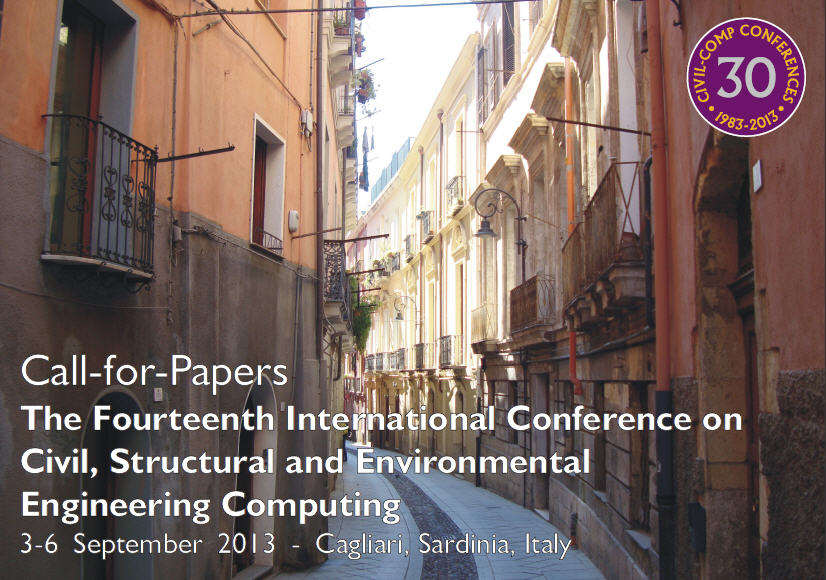
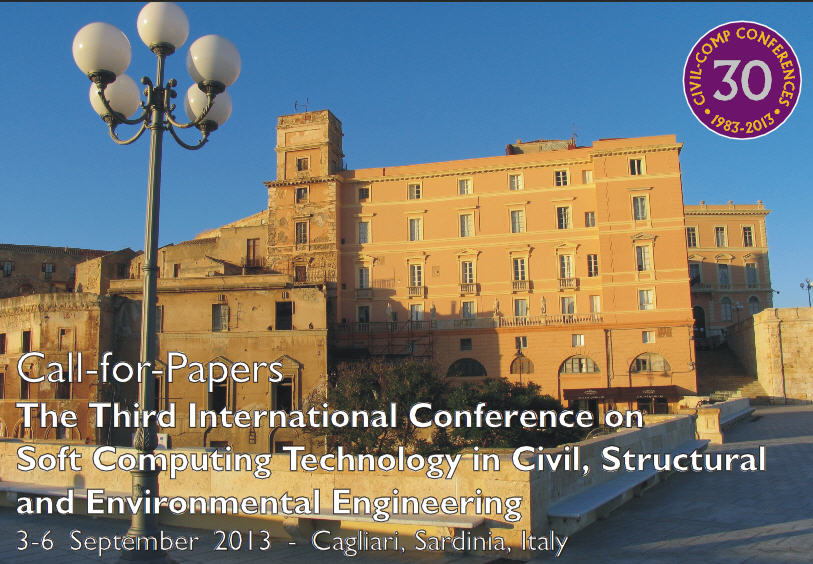
The Fourteenth International Conference on Civil, Structural and Environmental Engineering Computing

The Fourteenth International Conference on Civil, Structural and Environmental Engineering Computing
3-6 September 2013 – Cagliari, Sardinia, Italy
http://www.civil-comp.com/conf
This is the fourteenth in the CIVIL-COMP series of conferences concerned with the application of computers to civil, structural and environmental engineering. The first Civil-Comp Conference was held in 1983. The conference will provide a forum for the presentation and dissemination of recent developments in the use of computers in civil, structural and environmental engineering. A major objective of the conference will be to link research and innovative ideas to engineering practice. Short to medium length papers describing the application of computers to civil, structural and environmental engineering projects will be particularly welcome. In addition, it is hoped that significant research and review papers on civil, structural and environmental engineering computational research topics will be presented.

The Third International Conference on Soft Computing Technology in Civil, Structural and Environmental Engineering

The Third International Conference on Soft Computing Technology in Civil, Structural and Environmental Engineering 3-6 September 2013 – Cagliari, Sardinia, Italy
http://www.civil-comp.com/conf

Topics: Soft computing technology includes aspects of computer science, artificial intelligence, machine learning, evolutionary based methods and tools. Many of the methods employed by soft computing technology are computationally intensive and should therefore only be employed on complex problems that have traditionally proved intractable using more conventional solution methods. The key areas of soft computing covered by this conference include but are not limited to: neural networks; fuzzy systems; genetic algorithms; ant colony optimization; evolutionary algorithms; simulated annealing; harmony search; cellular automata; swarm intelligence; Bayesian networks; chaos theory; data mining; meta-heuristic methods. Papers describing the application of the above techniques to all branches of civil, structural and environmental engineering may be submitted to the conference.

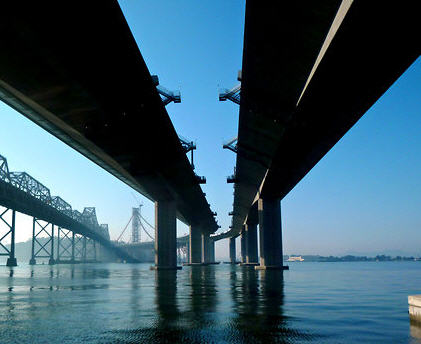
New Oakland Bay Bridge


SAN FRANCISCO — Venture deep inside the new skyway of the San
Francisco-Oakland Bay Bridge, and it becomes clear that the bridge’s
engineers have planned for the long term. 

At intervals inside the elevated roadway’s box girders — which have the
closed-in feel of a submarine, if a submarine were made of concrete —
are anchor blocks, called deadmen, cast into the structure. They are
meant to be used decades from now, perhaps in the next century, when in
their old age the concrete girders will start to sag. By running cables
from deadman to deadman and tightening them, workers will be able to
restore the girders to their original alignment.
The deadmen are one sign that the new eastern span
of the Bay Bridge, which includes the skyway and a unique suspension
bridge, is meant to last at least 150 years after its expected opening
in 2013. (The existing eastern bridge, which is still in use, will then
be torn down.)
But to make it to the 22nd century, the new span may at some point have
to survive a major earthquake, like the one that destroyed much of San
Francisco in 1906 or the one that partly severed the Bay Bridge in 1989.
With two faults nearby that are capable of producing such large quakes,
survival is no simple matter.
Say what you want about the project — and as the construction timeline
has lengthened past a decade and costs have soared over $6 billion,
plenty has been said — keeping the bridge intact in an earthquake has
always been the engineers’ chief goal.
And to meet that goal, they are going with the flow: designing flexible
structures in which any potential damage would be limited to specific
elements.
“We wanted to make this bridge flexible so that when the earthquake
comes in, the flexibility of the system is such that it basically rides
the earthquake,” said its lead designer, Marwan Nader, a vice president
at the engineering firm T. Y. Lin International.
That contrasts with another potential approach: making the bridge
structures large enough, and rigid enough, to resist movement. “Massive
and stiff structures would look absolutely ugly and be very, very
expensive,” said Frieder Seible, dean of the Jacobs School of
Engineering at the University of California, San Diego, who tested many
elements of the bridge design.
That design includes a 525-foot-tall suspension bridge tower made up of
four steel shafts that should sway in a major earthquake, up to about
five feet at the top. But the brunt of the force would be absorbed by
connecting plates between the shafts, called shear links.
The bridge’s concrete piers are designed to sway as well, limiting
damage to areas with extra steel reinforcing. And at joints along the
entire span there are 60-foot sliding steel tubes, called hinge pipe
beams, with sacrificial sections of weaker steel that should help spare
the rest of the structure as it moves in a quake.
“At the seismic displacement that we anticipate, there will be damage,”
Mr. Nader said. “But the damage is repairable and the bridge can be
serviceable with no problems.”
Emergency vehicles and personnel, at the least, should be able to use
the bridge within hours of a major earthquake, after crews inspect the
structure and make temporary fixes, like placing steel plates over
certain joints. Given that the Bay Area’s two major airports would be
expected to be out of service after such a disaster, this bridge and the
Benicia-Martinez Bridge, another seismically secure span about 20 miles
to the northeast, would be “lifeline” structures to bring assistance to
the stricken region from an Air Force base inland, said Bart Ney, a
spokesman for the California Department of Transportation.
It was an earthquake that made this replacement span, which runs for 2.2
miles between Oakland and Yerba Buena Island in the middle of San
Francisco Bay, necessary. The Loma Prieta quake of 1989, the first to
occur along the San Andreas fault zone since the 1906 disaster, caused
part of the existing steel-truss span to collapse,
killing a motorist. The bridge was closed for a month. That quake, with
a magnitude of 6.9, caused strong shaking that lasted about 15 seconds
and movement far greater than the 1930s-vintage bridge had been designed
to handle. 
Πηγή: New York Times