
NEES “Research to Practice” Webinar “Assessment of Seismic Performance of Masonry-Infilled Reinforced Concrete Frames”

Assessment of Seismic Performance of Masonry-Infilled Reinforced Concrete Frames” is the sixth in a series of Research to Practice webinars
co-produced by the Network for Earthquake Engineering Simulation (NEES)
and the Earthquake Engineering Research Institute (EERI) is Tuesday,
May 22, 2012.

 

There is no cost to attend this webinar. To register go to https://nees.org/webinar.  
Reinforced
concrete and steel frame structures sometimes include unreinforced
masonry infill walls as interior and exterior partitions. Such
construction can be found in many old buildings in the western United
States, such as pre-1930’s buildings in California, and is still being
used for newer buildings in the midwestern and eastern parts of the
country. Even though unreinforced masonry infill walls are usually
considered as non-structural elements, they interact with the bounding
frames when subjected to earthquake loads. This interaction may result
in unintended failure mechanisms, such as shear failures of reinforced
concrete (RC) columns and the crushing of the masonry infill. The
seismic performance and safety of infilled frames have received much
attention because of their mixed performance in past earthquakes. The
lateral load resistance of an infilled frame highly depends on the
frame-wall interaction and the specific failure mechanism that may
result. This presents a major challenge for the performance assessment
of these structures.

A
research project was sponsored under the Network for Earthquake
Engineering Simulation (NEES) program of NSF to develop reliable
analytical methods for assessing the performance of masonry-infilled RC
frames, and also effective retrofit methods for enhancing the seismic
safety of these buildings. The analytical and retrofit methods were
validated with quasi-static and large-scale shake-table tests. The
research was a collaborative effort of UC-San Diego, the University of
Colorado, Boulder, and Stanford University. This webinar will provide a
brief overview of the research project, and present the simplified as
well as refined analytical methods that were developed in this project.
Current efforts to improve the performance assessment methods in ASCE 41
for this type of structures will be discussed. The presentation will be
given by Professor P.B. Shing and Dr. Ioannis Koutromanos of UC-San
Diego, and Professor Andreas Stavridis of the University of Texas,
Arlington.
The Mid-America Earthquake Center’s report on the Maule (Chile) Earthquake of February 27, 2010 is now available

The Mid-America Earthquake (MAE) Center reconnaissance report on the Maule (Chile) earthquake of February 27, 2010 is now available from http://mae.cee.uiuc.edu/publications/2010/10-04.htm. The report includes observations of the MAE Center team on the damaged ports, buildings, bridges, and historical structures. A detailed chapter on engineering seismology develops spectrum compatible ground motions for various sites in Chile that are proposed for use in risk assessment studies. Two bridges and a building structure that exemplified the most commonly observed failures are selected, advanced numerical models are built, and inelastic dynamic analyses are conducted to provide further insight to the field observations. The report also features a dedicated chapter on transportation networks, roads and embankments where the performance is assessed using field data. Another chapter focuses on the role of media after the earthquake and provides useful insight on the response of the affected population to communicate in the aftermath of a disaster.

6th European Workshop on the seismic behaviour of Irregular and Complex Structures (6EWICS)

The 6th European Workshop on the seismic behaviour of Irregular and Complex Structures (6EWICS) will take place on Sep. 12-13, 2011, at the Technion – Israel Institute of Technology in Haifa, Israel.

Please note that the submission date has been moved forward, hence the important dates are as follows:
January 31, 2011: Submission of abstracts;

May 15, 2011: Acceptance of abstracts;
June 30, 2011: Submission of final papers

Abstracts submission should include the title of the paper, a 250 -500 word abstract of the paper and the author or a list of authors if appropriate.  Please be certain to include the following: objective, methodology, results and conclusions. Please also identify the expected presenter. For each author, please include their name, affiliation, mailing address, e-mail, phone and fax numbers.
 

IABSE Conference Cairo 2012

The IABSE Conference ‘Global Thinking in Structural Engineering: Recent Achievements’will be hosted by the Egyptian Group of IABSE and the Egyptian Society of Engineers from
May 7-9, 2012. Participants are invited to submit abstracts in English to the following themes:
1. Structural Engineering as part of Multi-disciplinary Systems
2. Sustainable Development and Structural Engineering
3. Structural Engineering and Renewable Energy Sources
4. Smart Structures, New Materials and Construction Techniques
For more information and submission of abstracts: www.iabse.org/cairo2012

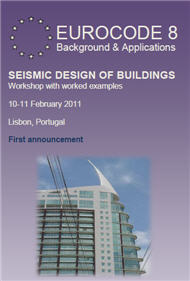
EUROCODE 8: Background and Applications Workshop “Seismic Design of Buildings” with worked examples, Lisbon, 10-11 February 2011

Eurocode 8 Workshop “Seismic Design of Buildings” with worked examples, co-organized by the Joint Research Center of the European Commission, CEN/TC250/ Sub-Committee 8 and the National Laboratory for Civil Engineering (LNEC). This major European event on dissemination of information for training on the Eurocodes will take place in Lisbon on 10-11 February 2011. This workshop will have emphasis on worked examples and intends to contribute towards the transfer of background knowledge and expertise of Eurocode 8 writers (CEN/TC250/Sub-Committee 8) to potential trainers at national level and Eurocode users. Please find attached the first announcement of the workshop. It is also accessible on http://eurocodes.jrc.ec.europa.eu/showpage.php?id=335 where you can also find additional information on the workshop.
Please note the deadline for registration, 15 December 2010. Interested participants can register online at https://jrc-meeting-registration.jrc.ec.europa.eu .

PEER’s Guidelines for Performance-Based Seismic Design of Tall Buildings

PEER Center is pleased to announce the release of the “Guidelines for Performance-Based Seismic Design of Tall Buildings” that was developed by PEER’s Tall Buildings Initiative.

The Guidelines present a recommended alternative to the prescriptive procedures for seismic design of buildings contained in standards such as ASCE 7 and the International Building Code (IBC). They are intended primarily for use by structural engineers and building officials engaged in the seismic design and review of individual tall buildings.

Properly executed, the Guidelines are intended to result in buildings that are capable of achieving the seismic performance objectives for Occupancy Category II buildings intended by ASCE 7. Alternatively, individual users may adapt and modify these Guidelines to serve as the basis for designs intended to achieve higher seismic performance objectives.

The Guidelines were developed considering the seismic response characteristics of tall buildings, including relatively long fundamental vibration period, significant mass participation and lateral response in higher modes of vibration, and a relatively slender profile. Although the underlying principles are generally applicable, the Guidelines were developed considering seismic hazard typical in the Western United States.

The Working Group members that prepared the guidelines include: Yousef Bozorgnia (PEER, UC Berkeley)C.B. Crouse (URS Consultants)Ronald Hamburger, Chair (Simpson Gumpertz & Heger)Ronald Klemencic (Magnusson Klemencic Associates)Helmut Krawinkler (Stanford University)James Malley (Degenkolb Engineers)Jack Moehle, Co-Chair (PEER, UC Berkley)Farzad Naeim (John A. Martin & Associates)Jonathan Stewart (UC Los Angeles) View and download the free electronic pdf version of the Guidelines (PEER Report No. 2010/05)

Request a Free Copy of the GuidelinesAs a part of the launch of the new Guidelines document, PEER is offering one free copy of the printed Guidelines to engineering offices located in the United States (while supplies last). To receive your free copy, please submit a request via PEER’s online request form.Online Request Form for TBI GuidelinesNote that only one copy will be sent to each engineering design office, so please coordinate within your firm or office so that only one request is sent. Additionally, all of PEER’s Business and Industry Partners (BIP) have already been sent several copies of the Guidelines and do not need to request another copy. Check if your firm is a PEER BIP. PEER News Alerts

NEES/EERI Educational Webinar Series Kicks Off January 14, 2011!

Join Friday, January 14, from 11:30 a.m. to 1:00 p.m. Pacific Time for Performance-Based Seismic Design of Mid-Rise Light-Frame Wood Buildings, the first webinar of the George E. Brown, Jr. Network for Earthquake Engineering Simulation (NEES)/ Earthquake Engineering Research Institute (EERI) engineering educational series, Reducing Earthquake Losses: From Research to Practice.  To register, click here and follow the prompts using event #666 946 334 and the event password, NEES. The program will summarize key findings of the ground-breaking NEESWood project, suggest design approaches, and discuss forthcoming code implications.  Presenters NEESWood Principal Investigator John W. van de Lindt and Steve Pryor, International Director of Building Systems, Simpson Strong-Tie, will provide a brief overview, describe the major tests on two and six-story full-scale buildings, and explain the SAPWood modeling software. The webinar series is geared for both engineering practitioners and researchers, featuring the outcomes of NEES research projects and highlighting the significance of the results for improved engineering design and construction. Future programs are forthcoming.

NEES Research Experience for Undergraduates (REU) 2011 Application

NEES Research Experience for Undergraduates (REU) 2011 Applications Open
Six NEES equipment sites will host REU students in summer 2011: Oregon State; University of California, Los Angeles; University of California, Santa Barbara; University of Illinois, Urbana-Champaign; Lehigh University, and University of Nevada, Reno.  The dynamic 10-week summer research program is geared for upper division undergraduate students interested in civil, electrical or computer engineering, and other fields related to seismic risk mitigation. Students collaborate with graduate students and faculty on NEESR projects.
Candidates must have a minimum GPA of 3.0 for acceptance; NSF limits participation to U.S. citizens and permanent residents of the United States.   Aspirants are asked to include personal educational data, contact information, references, background demographics, identify specific completed engineering and math courses and skill proficiency, respond to three essay questions, and rank the preferred research site out of the six participating locations.  Please encourage your students to apply at REU Program Application.
NEESR researchers who are applying to NSF for REU supplements on their NEESR projects but would like to have their students also participate in the NEEScomm REU program activities should apply by clicking here.

Applications are due no later than 8:00 a.m. PDT on February 28, 2011.