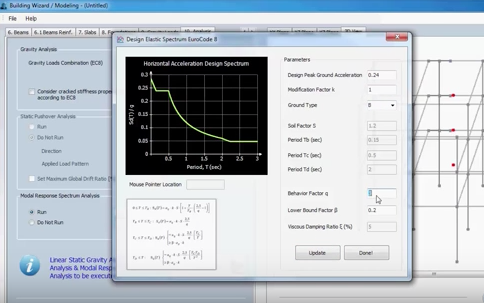
Building Wizard 2.0 is a FREEWARE, interactive front-end software for the seismic analysis and assessment of buildings structures, that takes advantage of a sophisticated, Open-Source software for Earthquake Engineering Simulation (OpenSees) to provide through its graphical user’s interface: (a) conceptual assistance during the finite element analysis pre- and post-processing (b) finite element model development automations and (c) expert advice for modeling various building-specific issues that are key for the reliable prediction of structural response (such as shear wall connections, soil-structure interaction etc). Building Wizard improves the efficiency and credibility of the finite element modeling developed, particularly for the case of complex buildings structures and gives the designer more control in critical modeling decisions affecting the overall system response.
Civil Engineering Toolbox is a revolutionary way to perform simple and some not-so-simple, structural engineering calculations using iPad. It is not about solving complex math but rather about understanding and conceptually decoupling the fundamental steps of structural engineering: (a) define the structural system, (b) define the loading patterns acting on the structure, (c) select material properties from a database, (d) select sections from a database, (e) check the developed stresses, the displacements and the associated cost. If acceptable, that’s fine; if not, the user needs to think carefully which one of (a)-(d) need to be modified to get the optimum balance between safety factor and cost. In case it is needed, a photo can be captured on site and the entire calculation package can be sent to the office computer by e-mail together with the exact GPS location of the site.
With Civil Engineering Toolbox, the engineer can perform the following tasks:
-Design a reinforced concrete beam in flexure [required reinforcement and associated cost]
-Solve a simply supported slab [for various supports and loads, according to Czerny method]
-Solve a straight, simply supported beam [for various supports and loads]
-Solve a one bay frame [for various supports and loads]
-Solve a continuous beam and plot deflections, bending moments and shear forces [for various number of spans, supports and uniform/non-uniform loads]
-Manage the Material Properties Library [reinforced concrete and steel materials]
-Manage the Structural Section Library [Rectangular R/C sections & IPE, HEA, HEB, IPN steel sections]
-Report generation and e-mail export (inclusive of results, photo and GPS location]
Sextos, A.G. (2013) “A Paperless Course on Structural Engineering Programming: investing in educational technology in the times of the Greek financial recession”, European Journal of Engineering Education.
This paper presents the structure of an undergraduate course entitled ‘programming techniques and the use of specialised software in structural engineering’ which is offered to the fifth (final) year students of the Civil Engineering Department of Aristotle University Thessaloniki in Greece. The aim of this course is to demonstrate the use of new information technologies in the field of structural engineering and to teach modern programming and finite element simulation techniques that the students can in turn apply in both research and everyday design of structures. The course also focuses on the physical interpretation of structural engineering problems, in a way that the students become familiar with the concept of computational tools without losing perspective from the engineering problem studied. For this purpose, a wide variety of structural engineering problems are studied in class, involving structural statics, dynamics, earthquake engineering, design of reinforced concrete and steel structures as well as data and information management. The main novelty of the course is that it is taught and examined solely in the computer laboratory ensuring that each student can accomplish the prescribed ‘hands-on’ training on a dedicated computer, strictly on a 1:1 student over hardware ratio. Significant effort has also been put so that modern educational techniques and tools are utilised to offer the course in an essentially paperless mode. This involves electronic educational material, video tutorials, student information in real time and exams given and assessed electronically through an ad hoc developed, personalised, electronic system. The positive feedback received from the students reveals that the concept of a paperless course is not only applicable in real academic conditions but is also a promising approach that significantly increases student productivity and engagement. The question, however, is whether such an investment in educational technology is indeed timely during economic recession, where the academic priorities are rapidly changing. In the light of this unfavourable and unstable financial environment, a critical overview of the strengths, the weaknesses, the opportunities and the threats of this effort is presented herein, hopefully contributing to the discussion on the future of higher education in the time of crisis.