Seventh National Seismic Conference on Bridges and Highways (7nsc)

“Bridge Resilience for Earthquakes and Other Natural Hazards”. Oakland May 20-22, 2013. 
The Seventh National Seismic Conference on Bridges & Highways is tailored to the needs of engineers working for state and local departments of transportation, design consultants, contractors, researchers, mangers, and others responsible for transportation facilities. International guests will be able to dialogue with others, share their successes and needs, and learn the latest approaches to design, retrofitting, geotechnology, inspection etc.

Seismic Strengthening of Hospitals

By NISEE
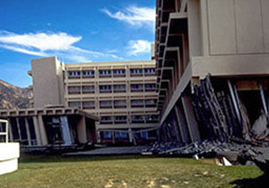
Hospital reconstruction and seismic strengthening provided continuous demand for construction design and engineering services in recent years. (See NISEE, Dec 9, 2011) In California, compliance with mandatory seismic performance objectives for critical health care facilities is largely supervised through the California Office of Statewide Planning and Development (OSPD). A hospital’s ability to function adequately after a large earthquake is dependent on the building’s structural components (a building’s primary load carrying system of foundation, columns, beams, floors, walls and roof), non-structural components (building elements such as ceilings, partitions, pipes, mechanical and electrical, that are not part of the structural load-bearing system), occupants (staff and patients) and contents (equipment, supplies, furnishings, etc.) remaining largely undamaged. Hospital serviceability after natural disaster relies on robust interconnectedness of lifeline systems (water, power, transportation, etc.) that support hospital services. The constitution of structural, non-structural and contents may provide unique seismic strengthening challenges for hospitals.


For seismic strengthening of modern hospital buildings, reliable site-specific loss estimation techniques (e.g.: Blume-157) can account for structural and non-structural damage. Engineering building codes (e.g.:ICBOFEMACalifornia Building Codes), applied research programs (e.g.: ATC-58MCEERJapan E-Defense) and sophisticated testing methodologies to analyze and strengthen structural and many non-structural systems to resist moderate to strong earthquake shaking or geotechnical damage are reasonably advanced. Video of recent shake-table testing at the University of California, San Diego (‘Building it Better: Earthquake-Resilient Hospitals for the Future’) confirms some ability to achieve both structural and non-structural hospital resilience after credible earthquakes in California. 


Read more / Original Source

A Brief History Of The Richter Scale


Enhanced by Zemanta

The California-Made Earthquake Alarm That Works But California Won’t Build

Source blog 

For all of the devastation caused by the 2011 earthquake/tsunami in Japan, the former, a 9.0 magnitude beast called “Tohoku,” could have claimed far more lives. The reason it didn’t? Since 2007, Japan has had an early warning system — conceived 10 years ago at Caltech — which California still hasn’t managed to set up. And while it only gives about a minute notice, it’s a minute Californians currently don’t have.
Until 2003, when Japanese seismologist Hiroo Kanamori and UC Berkeley’s Richard Allen published a study proving that early detection was possible, warning systems for earthquakes have relied on a concept that’s been around since the 19th century: detect the ground shaking at the fault line and send advanced notice to cities miles away through telegraphs, telephones, or modern telecommunications (depending on which century you’re in).
This system relies on the fact that electronic signals move much faster than seismic waves; For example, if you were in New York and on Twitter on August 23, 2011, you might have seen tweets from Washington DC about their earthquake just before the ground started shaking under your feet. As neat as that might have been (yay, new media!) retweeting is not a very good system for warning a city of impending seismic doom.
The new system put into place in Japan in 2007 detects earthquakes before they start shaking the Earth’s surface. Allen and Kanamori found that when tectonic plates shift, they release two forms of energy simultaneously, called p-waves and s-waves. S-waves cause all the damage on the surface. P-waves are harmless, but travel through the ground about twice as fast. So when Japan’s more than 1000 seismometers near their Pacific fault-line relayed p-wave data indicating a massive earthquake, the Japanese Meteorological Agency rang the alarm.
While this “early detection” still only gives about 60 seconds of warning, Japan was able to safely stop 11 500km/h bullet trains, disable 16,000 lifts, warn students to get under their desks and set off earthquake alarms across the country. Some 52 million Japanese received text alerts on their mobile phones. But that’s because Japan has the advanced warning system and a cultural awareness of the threat of earthquakes (for example, new iPhones bought in Japan come with quake-warning features built in).
California, on the other hand? Azeen Ghorayshi, in a great feature for the East Bay Express about Japan and California’s preparedness, says that California still has “next to nothing in terms of a public seismic warning system,” despite knowing how to build one for almost a decade and despite knowing the next “big one” is only matter of time. But building a statewide system is only a matter of politics and money, so it’ll probably be ready in no time. Meanwhile, here’s a $1 iPhone Seismometer app that you can make into your own DIY not-so-advanced warning system. [East Bay Express]

Enhanced by Zemanta

Summer Program on Model Validation & Simulation

Bauhaus-Universität Weimar and 13 Partner Universities from Belgium, Bulgaria, Greece (Aristotle University of Thessaloniki), Hungary, Italy, Luxembourg, Portugal, United Kingdom, Switzerland and Turkey will present special topics of structural engineering in a summer program to be held August 4–16, 2013, at BauhausUniversität Weimar in Germany. The program is funded by the European Commission Lifelong Learning Programme. Through a challenging and demanding series of lectures, as well as seminars and project work, presented with state-of-the-art information and communication technology, this program seeks to impart knowledge and to combine research with a practical context. The course is tailored to advanced master’s and doctoral candidates in the fields of structural engineering, numerical simulation and modeling, and their applications to natural hazards, risk management, geodynamics, and foundation engineering. The course language is English. The course fee is €450. A small number of scholarships are available. A letter of application and an abstract must be submitted by May 15. For more information, visit http://www.uni-weimar.de/summerschool/mvs.

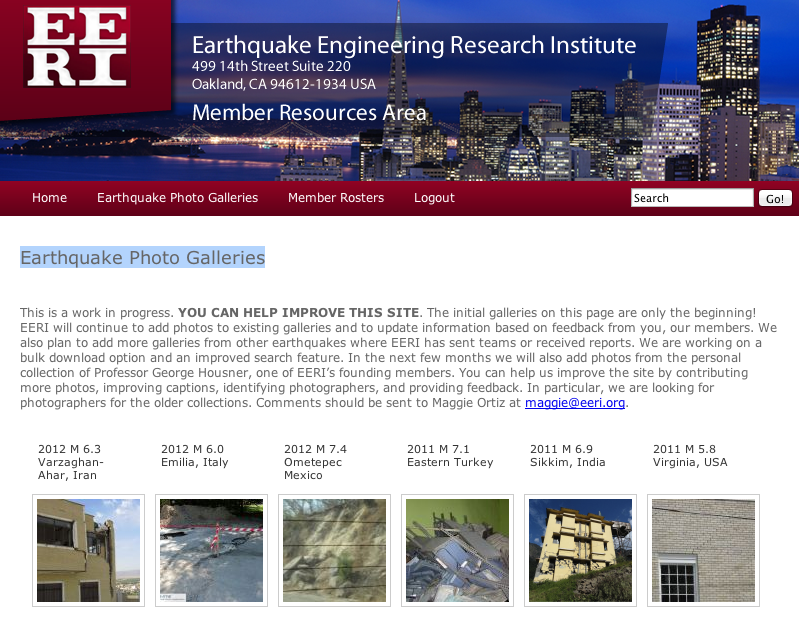
Earthquake Photo Galleries by EERI

EERI is launching a fantastic new resource for members only–online photo galleries from many recent and important earthquakes. Included are galleries for over 30 earthquakes. Each gallery features from 30 to 300 images and all photos are searchable by keyword. These initial galleries are only the beginning! EERI will continue to add new galleries and is working on a bulk download option and an improved search feature. In the next few months we will also add photos from the personal collection of Professor George Housner, one of EERI’s founding members. You can help us improve the site by contributing more photos, improving captions, identifying photographers, and providing feedback. Any comments should be sent to Chris Lee at Chris@eeri.org.

Preservation of Byzantine Antiquities at the Venizelou Metro Station, Thessaloniki

Official proposal of the Department of Civil Engineering regarding the preservation of Byzantine antiquities at the Venizelou Metro station, in Thessaloniki, Greece. Powerpoint presentation and Video illustration of the concept as presented during the Workshop organized by Aristotle University Thessaloniki on April 19th, 2013.
All four alternative solutions
Streaming of the Workshop

Α

Fukushima Earthquake (11/3/2011) documentary

Ντοκιμαντέρ του ΣΚΑΪ καταγράφει μέσα από συγκλονιστικές εικόνες τον σεισμό των 9 Ρίχτερ, το τσουνάμι και την πυρηνική καταστροφή στην Φουκουσίμα της Ιαπωνίας. Αυτόπτες μάρτυρες αλλά και επιστήμονες που βίωσαν και μελετούν αντίστοιχα αυτό το σεισμό και τις συνέπειες που προκλήθηκαν στην Ιαπωνία μιλούν στην κάμερα. Τα 9 Ρίχτερ που χτύπησαν την Ιαπωνία την Παρασκευή 11 Μαρτίου 2011 αποτέλεσαν τον πέμπτο μεγαλύτερο σεισμό που έχει καταγραφεί στον κόσμο από το 1900. Το τσουνάμι που ακολούθησε έφερε και τις εφιαλτικές συνέπειες των 10.000 και πλέον νεκρών αλλά και χιλιάδων αγνοουμένων. Ολόκληρες πόλεις χάθηκαν και τίποτα δεν είναι πια ίδιο για τους Ιάπωνες αλλά και ολόκληρο τον κόσμο μετά την καταστροφή που υπέστη το πυρηνικό εργοστάσιο της Φουκουσίμα

Eurocode 8-3 and Greek Code for Seismic Intervention (ΚΑΝ.ΕΠΕ.- GCSI:2012)

COUNCIL OF EUROPE/EUROPEAN CENTRE ON PREVENTION AND FORECASTING OF EARTHQUAKES (ECPFE)

EARTHQUAKE PLANNING AND PROTECTION ORGANIZATION (EPPO)
ATHENS WORKSHOP / EC 8-3 : 2005 and GCSI 2012, APRIL 12/2013

PROGRAMME
09:00/09:30 Welcome
09:30/09:45 K. Stylianidis Opening/General
09:45/10:15 M. Chronopoulos Main differences between EC8-3:2005 and GCSI:2012.
10:15/10:45 K. Stylianidis Basic principles of the GCSI – Performance Levels.
10:45/11:30 A. Kappos A pilot application of EC8-3. Reflections and comparisons with the GCSI.
11:30/11:45 Coffee break
11:45/12:30 S. Lagomarsino Performance based assessment of ancient masonry Buildings: Outcome of the European Project PERPETUATE.
12:30/13:00 M. Chronopoulos, P. Chronopoulos The GCSI and the RC infilled buildings.
13:00/13:45 V. Petkov Bulgarian seismic design codes and civil construction practice. Infilled reinforced concrete frames – Application and assessment of their resistance to lateral forces.
13:45/14:45 Light Lunch
.
14:45/15:30 I. Craifaleanu Implementation of the EC8-p.3:2005 – Assessment and Interventions on buildings in Earthquake prone areas.
15:30/16:15 M. Fardis Modelling of concrete members: Developments after the completion of EN 1998-3:2005.
16:15/16:30 Coffee break
16:30/17:00 S. Dritsos Differences in the design of structural interventions according to the EC 8-3 and the GCSI.
17:00/17:30 T. Tassios, N. Koutsia Some comparisons between retrofitting provisions of EC 8-3 and other Codes For R.C. elements.
17:30/19:00 Discussion