Earthquake Engineering Special Session organized with the framework of Fourteenth International Conference on Civil, Structural and Environmental Engineering Computing
An “Earthquake Engineering” Special Session is organized within the framework of Fourteenth International Conference on Civil, Structural and Environmental Engineering Computing, to be held in Cagliari, Sardinia, Italy between 3-6 September 2013. It is organized by Anastasios Sextos, Assistant Professor at Aristotle University of Thessaloniki.

The Special Session focuses on recent advances in Computational Earthquake Engineering and Structural Dynamics. More specifically, it will encourage contributions related to the mitigation of seismic risk, the design and assessment of
earthquake resistant buildings and bridges, the assessment of
special and monumental structures,
system identification and structural health
monitoring
, performance-based engineering, seismic
isolation and control of structures, dynamic soil-structure
interaction
, strong ground motion selection and scaling as well as
seismic wave propagation through the soil media.  Papers related to new
software applications, web-based engineering tools, frameworks for
hybrid simulation and distributed computing,
knowledge-based & expert
systems
,
finite
element programs, numerical analysis pre- and post- processing
front-ends, data and metadata dissemination and management
systems, high performance, parallel and cloud computing schemes,
applications for mobile devices and tablets as well as GIS-based
visualization tools are also welcome.

It is envisioned that the Special Session will constitute an interesting forum for scientists using state-of-the-art computational methods and tools for Earthquake Engineering purposes.

Please note that the call for papers closes on the 5th December 2012 and abstracts may be submitted via the conference website: http://www.civil-comp.com/conf/

To encourage young researchers to attend the conference a 1000 Euro Young Researcher Best Paper Prize will be awarded to the best paper presented at each of the conferences. (For further details please see the conference website).
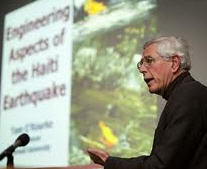
O’Rourke speaks about earthquake effects

Watch Live on March 7 or Watch Video on YouTube

PEER and the EERI Northern California Chapter jointly hosted the EERI distinguished lecture “The New Normal for Natural Disasters” by Professor Tom O’Rourke from Cornell University on December 6, 2012 at UC Berkeley.  This lecture discussed the effects of the Tohoku Earthquake and Tsunami, Canterbury Earthquake Sequence, and Hurricanes Katrina and Sandy with respect to their impact on regional and international economics, national practices for security and recovery, and worldwide energy policy.  The recording is now posted at PEER’s YouTube channel with the intermittent audio static from the live webcast removed. 
For those who would rather watch a live presentation, check out the opportunity towatch Professor O’Rourke live at Stanford University on March 7th as a part of the Shah Family Fund Distinguished Lecture Series.
Title: Earthquake Effects on Critical Infrastructure 
Speaker: Tom O’Rourke, Thomas R. Briggs Professor of Engineering, Cornell University
Date: March 7, 2013
Time: 4:30pm (Reception at 4:00pm)
Location:  Stanford University, Li Ka Shing Conference Center, LKS240/250 Directions
More information about this event can be found at the Blume Center’s website.
Abstract: The effects of the Tohoku Earthquake and Tsunami and Canterbury Earthquake Sequence are discussed with respect to their impact on regional and international economics, national practices for security and recovery, and worldwide energy policy. The lecture explains why these events require a fundamental re-thinking of the way we evaluate the risks of extreme events, as well as define and protect critical infrastructure. The impact of the Canterbury Earthquake Sequence on the underground infrastructure in Christchurch is explored with the use of an extraordinary GIS data set covering the effects of both liquefaction-induced permanent ground deformation and transient ground motion for 3 different earthquakes. Lessons learned from Christchurch for Wellington, NZ and San Francisco, CA are discussed. To address the need for protection against rare, high consequence events with limited financial resources, a strategy for improving infrastructure resilience is proposed.

Tenth U.S. National Conference on Earthquake Engineering

10th National Conference on Earthquake Engineering
Frontiers of Earthquake Engineering
July 21-25, 2014
Anchorage, Alaska

Purpose

The Tenth U.S. National Conference on Earthquake Engineering, on the 50th Anniversary of theGreat Alaska Earthquake and Tsunami, will provide an opportunity for researchers and practitioners to share the latest knowledge and techniques to mitigate the damaging effects of earthquakes and tsunamis. This conference is being planned by the Earthquake Engineering Research Institute (EERI) in collaboration with the George E. Brown, Jr. Network for Earthquake Engineering Simulation (NEES). The conference will provide a unique environment to facilitate synergy between professionals and student researchers from the U.S. and around the world. This conference brings together professionals from a broad range of disciplines, including architecture, structural engineering, seismology, geology, geophysics, geotechnical engineering, business, public policy, social sciences, regional planning, emergency response planning, and regulation.

Call for Papers

Authors must submit abstracts and papers online. The deadline for submission of abstracts is March 31, 2013. The abstract collection system will open January 7, 2013. Additional detailed instructions are available at the conference website http://www.10ncee.org.

Special Sessions

The conference will include a small number of Special Sessions. Those interested in organizing and chairing a Special Session should contact either of the Technical Program committee co-chairs, Scott Ashford (Scott.Ashford@oregonstate.edu) or Greg Deierlein (ggd@stanford.edu), by February 15, 2013.

More Information

For more information view the 1st Announcement and Call for Papers at http://10ncee.org/wp-content/uploads/2012/12/10NCEE_Call-for-Papers.pdf or visit the conference website at http://www.10ncee.org.

Earthquake Damage Database

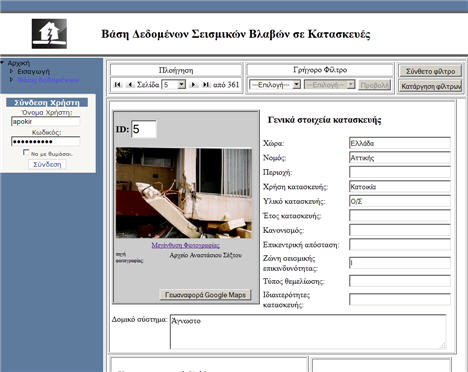
The Earthquake Damage Database has been launched, featuring a visual and fully searchable catalogue of structural damage due to earthquake loading in Greece. The database contains more than 300 photos with seismic-related metadata, georeference (where availlable) and commentary and aims to act as a visual educational tool for undergraduate and young Civil Engineers. Currently it is available only in Greek.
Official Website: http://asptetk.civil.auth.gr/Pages/Home.aspx
For further info or in case you are interested to submit your earthquake damage-related photos please contact: asextos@civil.auth.gr

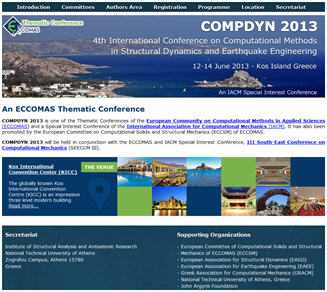
Minisymposium in ““Software Development in the Field of Earthquake Engineering and Structural Dynamics”

SUB

A minisymposium is organised in the framework of the 4th
International Conference on Computational Dynamics and
Earthquake Engineering
COMPDYN 2013
(www.compdyn2013.org)
:

Software Development in the Field of Earthquake Engineering and Structural Dynamics”.
 

Organizer:  Anastasios Sextos (Aristotle University of Thessaloniki, Greece)
 
e-mail:  asextos@civil.auth.gr
 descriptionThe mini-symposium
will focus on recent advances in software development for
Earthquake Engineering and Structural Dynamics purposes.
More specifically, it will encourage contributions that
will
demonstrate new
software applications, web-based engineering tools, frameworks for
hybrid simulation and distributed computing,
knowledge-based & expert
systems
,
finite
element programs, numerical analysis pre- and post- processing
front-ends, data and metadata dissemination and management
systems, high performance, parallel and cloud computing schemes,
applications for mobile devices and tablets as well as GIS-based
visualization tools. Emphasis will be primarily (but not
exclusively) given to the application of the above software
systems towards
the
mitigation of seismic risk, the design and assessment of
earthquake resistant buildings and bridges, the assessment of
special and monumental structures,
system identification and structural health
monitoring
, performance-based engineering, seismic
isolation and control of structures, dynamic soil-structure
interaction
, strong ground motion selection and scaling as well as
seismic wave propagation through the soil media. It is envisioned that the Symposium will constitute a forum
on the recently developed earthquake-engineering-related software
that will facilitate the dissemination of knowledge and promote the
interaction and cooperation between the developers and the
end-users.

A complete list of other interesting Minisymposia can be found here 

IN ORDER TO SUBMIT YOUR ABSTRACT PLEASE USE MINI-SYMPOSIUM CODE: MS-25-CZ

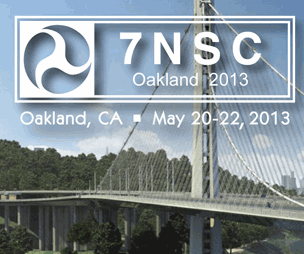
Seventh National Seismic Conference on Bridges & Highways (7NSC) “Bridge Resilience for Earthquakes and Other Natural Hazards”

Oakland,
California has been selected as the site of the Seventh National
Seismic Conference on Bridges & Highways (7NSC). The event will be
held May 20-22, 2013 at the Oakland Marriott City Center. The conference
theme is “Bridge Resilience for Earthquakes and Other Natural Hazards,”
indicating a broad scope. There will be presentations and discussions
of multiple hazards that may affect the performance of highway
infrastructure. California was chosen by the Federal Highway
Administration
(FHWA) to host this conference based on the state’s past
experience with earthquakes and the Department of Transportation’s
(Caltrans) leadership in the field. 
D2BS98J4TVJZ
Co-organizers
of the conference are USDOT Federal Highway Administration,
Transportation Research Board, American Association of State Highway and
Transportation Officials
’ Subcommittee on Bridges and Structures
(AASHTO), and earthquake research centers PEER-UC Berkeley, and MCEER,
University at Buffalo.
The
2013 conference builds upon previous successful meetings that have been
held in San Diego, Sacramento, Portland, Memphis, San Mateo, and
Charleston, SC. Based on past trends, attendance is expected to exceed
400 and will include representatives from private engineering practice,
government, construction, academia, and industry. This conference is a
premier gathering of transportation officials responsible for addressing
and mitigating the impact of all hazards on our highway infrastructure.
On
Sunday May 19, 2013, an optional pre-conference technical workshop will
be held. The main program will be held over the next 2½ days with over
75 oral and poster presentations, discussion panels, and a student
design competition. Several internationally renowned keynote speakers
are being invited to share information about some of the major
earthquakes that have occurred in other parts of the world in recent
years. In addition, a special session is planned that will highlight the
design and construction of the soon to be complete San Francisco –
Oakland Bay Bridge
, with emphasis on the unique self-anchored suspension
span. An optional technical tour will also be provided.
In
the days prior to the 7NSC, FHWA is planning to hold the First
International Bridge Seismic Workshop, also in Oakland. Dr. W. Phillip
Yen, FHWA Principal Bridge Engineer – Structural Dynamics, is Chairman
of the 7NSC and the International Workshop.

For more information, visit the conference web site.

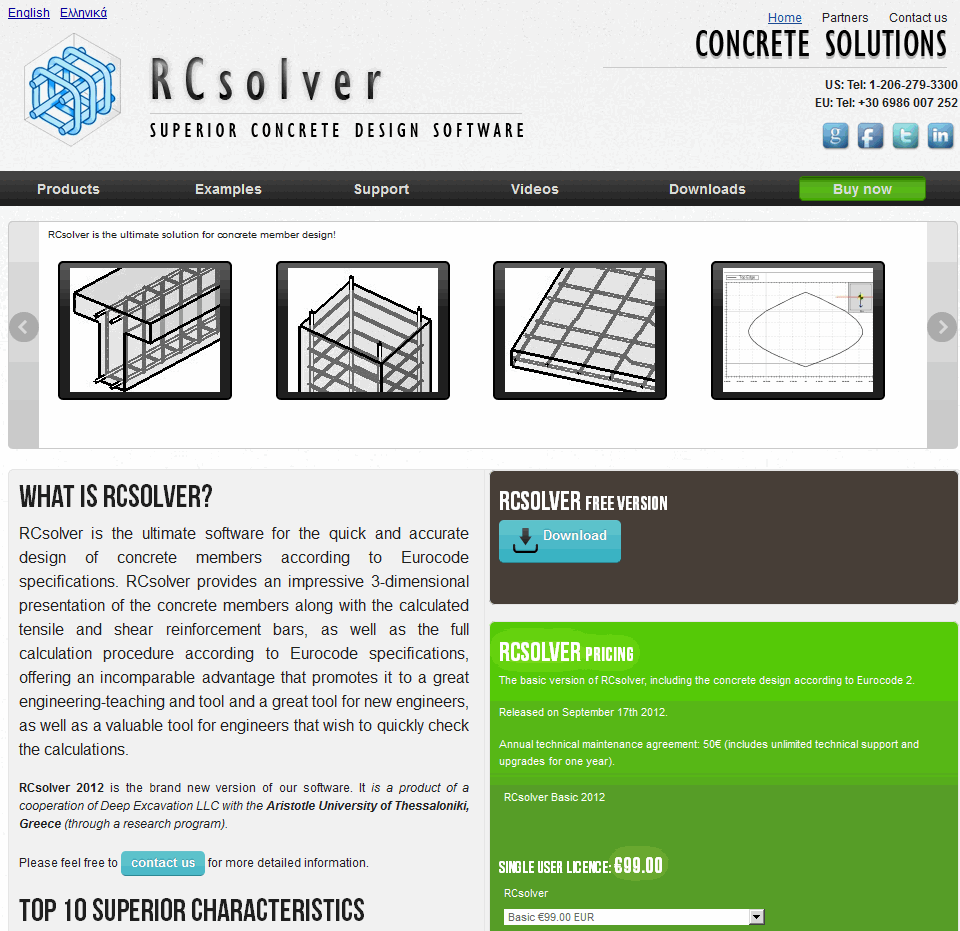
RCSolver Concrete design software to Eurocodes

RCsolver is a software for
the quick and accurate design of concrete members according to Eurocode
specifications (primarily 2 and 8). RCsolver provides a 3-dimensional
presentation of the concrete members along with the calculated tensile
and shear reinforcement bars, as well as the full calculation procedure
according to Eurocode specifications, acting as a great engineering-teaching as well as a valuable tool for engineers that
wish to quickly check their calculations. 

RCSolver free version is available at the software website

Impressive new exhibit at the California Academy of Sciences in San Francisco

Director Stephen Mahin’s recent research test for the NEEStips project at the nees@berkeley lab is featured in a new exhibit at the California Academy of Sciences in San Francisco.  The new exhibit, called “EARTHQUAKE: Life on a Dynamic Planet,” explores the seismic science that has shaped Earth’s evolution and continues to impact our lives today.

A key feature of the new exhibit is the Earthquake planetarium show, in the largest all-digital planetarium in the world.  The show explores the forces that transform the earth’s surface by examining the San Andreas Fault and San Francisco’s 1906 earthquake.  The show concludes with a focus on how engineers today help buildings resist earthquake shaking safely and highlights the benefits of earthquake resisting features, such as seismic isolation.

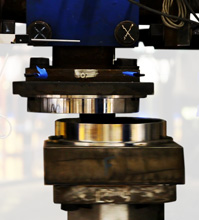
The nees@berkeley staff and researchers worked closely with the California Academy of Sciences to film the seismically isolated two bay, two story specimen that was being tested on nees@berkeley’s new hybrid shaking table.  The final resulting footage used in the planetarium show depicts the specimen being shaken as it zooms into a close up to one of the isolators.  If you go to see the planetarium show, be sure to look for the nees@berkeley team in the credits!

For more information about research highlighted in the planetarium show, watch an interview with Professor Mahin about the NEEStips testing at UC Berkeley.  Professor Keri Ryan of University Nevada, Reno is the PI of the NEEStips research program.

For more information about the California Academy of Science exhibit, visit the “EARTHQUAKE: Life on a Dynamic Planet” website.

To watch the Academy’s “Science in Action” video trailer highlighting the filming process and the importance of earthquake engineering research at PEER and nees@berkeley, visit the ScienceToday website.

Seismo-Artif: a new freeware for generating artificial earthquake accelerograms

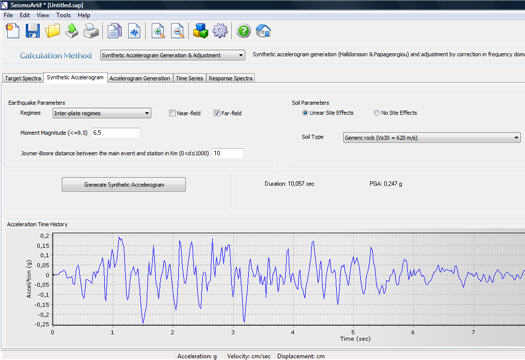
Seismosoft has announced the release of SeismoArtif, an application capable of generating artificial
earthquake accelerograms matched to a specific target response spectrum
using different calculation methods and varied assumptions. In other
words, the ideal companion tool of SeismoMatch, to be used in those cases where spectrum matching of real accelerograms is not pursuable.

In
tandem with this new release, Seismosoft has also published new versions of
SeismoSignal, SeismoSpect and SeismoMatch. In the News
 section of the official website it is possible to get a glimpse of the novelties and
improvements introduced in these programs, which can all be downloaded
from here