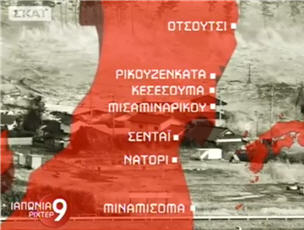
Ντοκιμαντέρ του ΣΚΑΪ καταγράφει μέσα από συγκλονιστικές εικόνες τον σεισμό των 9 Ρίχτερ, το τσουνάμι και την πυρηνική καταστροφή στην Φουκουσίμα της Ιαπωνίας. Αυτόπτες μάρτυρες αλλά και επιστήμονες που βίωσαν και μελετούν αντίστοιχα αυτό το σεισμό και τις συνέπειες που προκλήθηκαν στην Ιαπωνία μιλούν στην κάμερα. Τα 9 Ρίχτερ που χτύπησαν την Ιαπωνία την Παρασκευή 11 Μαρτίου 2011 αποτέλεσαν τον πέμπτο μεγαλύτερο σεισμό που έχει καταγραφεί στον κόσμο από το 1900. Το τσουνάμι που ακολούθησε έφερε και τις εφιαλτικές συνέπειες των 10.000 και πλέον νεκρών αλλά και χιλιάδων αγνοουμένων. Ολόκληρες πόλεις χάθηκαν και τίποτα δεν είναι πια ίδιο για τους Ιάπωνες αλλά και ολόκληρο τον κόσμο μετά την καταστροφή που υπέστη το πυρηνικό εργοστάσιο της Φουκουσίμα
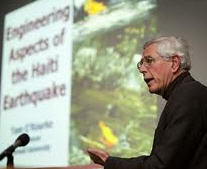
PEER and the EERI Northern California Chapter jointly hosted the EERI distinguished lecture “The New Normal for Natural Disasters” by Professor Tom O’Rourke from Cornell University on December 6, 2012 at UC Berkeley. This lecture discussed the effects of the Tohoku Earthquake and Tsunami, Canterbury Earthquake Sequence, and Hurricanes Katrina and Sandy with respect to their impact on regional and international economics, national practices for security and recovery, and worldwide energy policy. The recording is now posted at PEER’s YouTube channel with the intermittent audio static from the live webcast removed.
For those who would rather watch a live presentation, check out the opportunity towatch Professor O’Rourke live at Stanford University on March 7th as a part of the Shah Family Fund Distinguished Lecture Series.
Title: Earthquake Effects on Critical Infrastructure
Speaker: Tom O’Rourke, Thomas R. Briggs Professor of Engineering, Cornell University
Date: March 7, 2013
Time: 4:30pm (Reception at 4:00pm)
Location: Stanford University, Li Ka Shing Conference Center, LKS240/250 Directions
Abstract: The effects of the Tohoku Earthquake and Tsunami and Canterbury Earthquake Sequence are discussed with respect to their impact on regional and international economics, national practices for security and recovery, and worldwide energy policy. The lecture explains why these events require a fundamental re-thinking of the way we evaluate the risks of extreme events, as well as define and protect critical infrastructure. The impact of the Canterbury Earthquake Sequence on the underground infrastructure in Christchurch is explored with the use of an extraordinary GIS data set covering the effects of both liquefaction-induced permanent ground deformation and transient ground motion for 3 different earthquakes. Lessons learned from Christchurch for Wellington, NZ and San Francisco, CA are discussed. To address the need for protection against rare, high consequence events with limited financial resources, a strategy for improving infrastructure resilience is proposed.
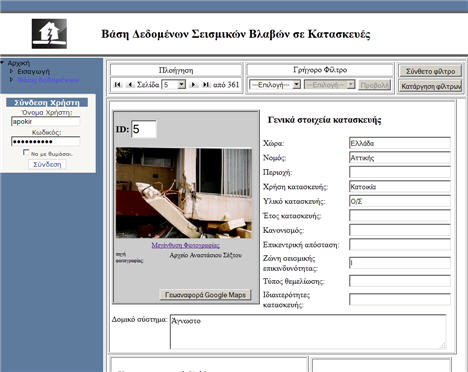
The Earthquake Damage Database has been launched, featuring a visual and fully searchable catalogue of structural damage due to earthquake loading in Greece. The database contains more than 300 photos with seismic-related metadata, georeference (where availlable) and commentary and aims to act as a visual educational tool for undergraduate and young Civil Engineers. Currently it is available only in Greek.
Official Website: http://asptetk.civil.auth.gr/Pages/Home.aspx
For further info or in case you are interested to submit your earthquake damage-related photos please contact: asextos@civil.auth.gr
PRESS RELEASE ============= It is with
great regret that we have been informed about the primary conviction of
seven Italian scientists, considered responsible for the loss of human life
during the recent earthquake in L’Aquila. With deepest respect for each and
every human life lost due to this natural disaster, the Hellenic Society for Earthquake Engineering, would like to note the following:
– It is
commonly accepted within the scientific community worldwide, that there cannot
be a short-term prediction of earthquakes, nor can it be an accurate
determination of the space, time and intensity of a future seismic event. For
this reason, it is practically impossible to take any essential precaution
measures for the protection of citizens in an area that is sufficiently narrow
and within a reasonably short period of time. Citizens and the State ought to
know the limits of scientific knowledge and to accept the large uncertainties
associated with the prediction of seismic activity, which is unfortunately
still impossible to overcome. From a scientific point of view and in accordance
with all international guidelines and state-of-practice, the Italian colleagues
acted as any other scientist would have in a similar position.
– The
criminalization of the inherent scientific inability to exceed the current
state of knowledge, is not only unjust for the persons in charge of the Italian
National Commission for the Forecast and Prevention of Major Risks, who have
contributed at a great extent in the mitigation of seismic risk. It is expected
to inactivate all relevant Civil Protection Departments in Italy and worldwide,
which will be reluctant to act in the future based on actual data. This phobic
crisis management may also result into a seriously misleading assessment of the
probabilistic nature of seismic hazard. This fact alone may have severe
consequences on the economic and social life of all regions exposed to seismic
risk internationally. Most importantly, it raises serious questions regarding
the way in which the State and society view the scientific progress as a whole.
Based on
the above, we would like to express the full and unreserved support of the
Hellenic Department of Earthquake Engineering to the convicted colleagues. We
do hope that the Italian Authorities will beneficially assess the validity of
our allegations.
Prof.
Kyriazis Pitilakis
Chairman
of the HSEE
Assist. Prof. Anastasios Sextos
Secretary of HSEE
HELLENICSOCIETY for EARTHQUAKEENGINEERING [ HSEE ]
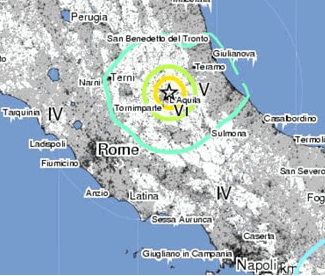
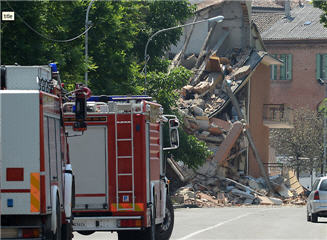
MIRANDOLA, Italy (AP) — A powerful earthquake killed at least 15 people
as it rocked a swath of northern Italy on Tuesday. Factories and
churches collapsed, dealing another blow to a region where thousands are still homeless after a stronger quake just nine days ago.
The 5.8 magnitude quake added to the misery being felt in the Emilia
Romagna region of towns north of Bologna, one of Italy’s most
agriculturally and industrial protective areas.
The quake hit just after 9:00 a.m. with an epicenter 40 kilometers (25
miles) northwest of Bologna, according to the U.S. Geological Survey —
just a handful of (miles) kilometers away from where the deadly May 20
quake was centered.
The quake was felt from Piedmont in northwestern Italy to Venice in the
northeast and as far north as Austria. It was followed by many
aftershocks, some registering more than 5.0 in magnitude.
Συντάχθηκε από nisida στις . Καταχωρήθηκε στο σεισμοί.
The History Channel will present Megaquake 10.0 on Wednesday, January 12, at 9 p.m. Eastern Time. The two-hour, non-fiction special explores one of the most deadly and perplexing mysteries that surrounds planet earth: huge megaquakes. The largest quake ever recorded was a 9.5 earthquake off of Chile in 1960, but new research shows how even larger quakes close to 10.0 just might be possible. Through interviews with top earthquake experts and cutting edge scientific experiments, the special reveals that more than three billion people on earth are in immediate danger from the next big one and how a real 10.0 might actually happen on US soil – in places you might not expect. Several NEES laboratories were contacted and interviewed during the production phase including Oregon State University; University of California, San Diego; University of California, Davis; and the University of Buffalo, SUNY.
Dr. Hermann M. Fritz, Assistant Professor, School of Civil and Environmental Engineering, Georgia Institute of Technology, said, “This documentary will include some of our experiments during fall 2010 at Oregon State University (OSU) with the Tsunami by Landslide project.“ Tom Albrechcinski, NEES@Buffalo site operations manager, said, “NEES@Buffalo provided high-resolution video footage of the projects including NEESWood, Georgia Tech Ports, the commissioning of the UB-NEES Nonstructural Component Simulator (NCS) “Hospital Room” tests and corresponded by email to clarify content.” The filmmakers filmed at both the W.M. Keck Center for Active Visualization in the Earth Sciences (KeckCAVES) and the Center for Geotechnical Modeling (CGM) at UCDavis. Dr. Ross Boulanger, NEES@UCDavis PI, is featured in the web short, which will be on the History Channel’s website.
The History Channel is part of A&E Television Networks (AETN) and is the leading destination for revealing, award-winning, original non-fiction series and event-driven specials that connects history with viewers in an informative, immersive and entertaining manner across multiple platforms.
A draft preliminary report on the April 4, 2010 El Mayor-Cucapah Earthquake is now available at the Baja California Clearinghouse website or by clicking here. This report contains observations from many field investigators. The authors encourage comments; they can be sent to Jorge Meneses at jmeneses@kleinfelder.com. A newsletter insert on this event will be published in the July EERI Newsletter.
Report of the National Science Foundation-Sponsored Geoengineering Extreme Events
Reconnaissance (GEER) Team
Editors:
Jonathan Bray (University of California, Berkeley) David Frost (Georgia Institute of Technology)
GEER Team Leaders:
Jonathan Bray (University of California, Berkeley) David Frost (Georgia Institute of Technology) Ramon Verdugo (Universidad de Chile) Christian Ledezma (Pontificia University Catolica de Chile)
Terry Elderidge (Golder Associates)
Report Lead Authors:
Pedro Arduino (University of Washington) Scott Ashford (Oregon State University) Dominic Assimaki (Georgia Institute of Technology) Jonathan Bray (University of California Berkeley) Terry Eldridge (Golder Associates) David Frost (Georgia Insistute of Technology) Tara Hutchinson (University of California, San Diego) Laurie Johnson (Laurie Johnson Consulting) Keith Kelson (Fugro William Lettis & Assoc.) Robert Kayen (US Geological Survey) Christian Ledezma (Pontificia Universidad Católica de Chile) Robb Moss (California Polytechnic University, San Luis Obispo) George Mylonakis (University of Patras) Scott Olson (University of Illinois) Kyle Rollins (Brigham Young University) Nicholas Sitar (University of California, Berkeley) Jonathan Stewart (University of California, Los Angeles) Alfredo Urzúa (Prototype Engineering Inc.) Ramon Verdugo (Universidad de Chile) Rob Witter (DOGAMI) Nick Zoa (University of Maryland)
Tο Ελληνικό Τμήμα Αντισεισμικής Μηχανικής (ΕΤΑΜ) Σας προσκαλεί την Τρίτη 20 Απριλίου (ώρα 6:30) στήν Διάλεξη του Dr. NicolasSitar Καθηγητή στο U.C. Berkeley Επισκέπτη Καθηγητή στο ΕΜΠ Με τίτλο : Ο Σεισμός Μw 8.8 της Χιλής :Σεισμολογική, Γεωτεχνική, Δομοστατική Αναγνώριση στην Αίθουσα Εκδηλώσεων της Πρυτανείας ΕΜΠ
Θα ακολουθήσει 10-λεπτη παρουσίαση απ’ τον Καθηγητή Γ. Γκαζέτα με θέμα :Ποιοτικές Συγκρίσεις των Πρόσφατων Σεισμών :Ιταλίας ( L’ Aquila), Αϊτής, Χιλής