Author: nisida

Freeware for section analysis of masonry and concrete structures

Freeware for section analysis of masonry and concrete structures

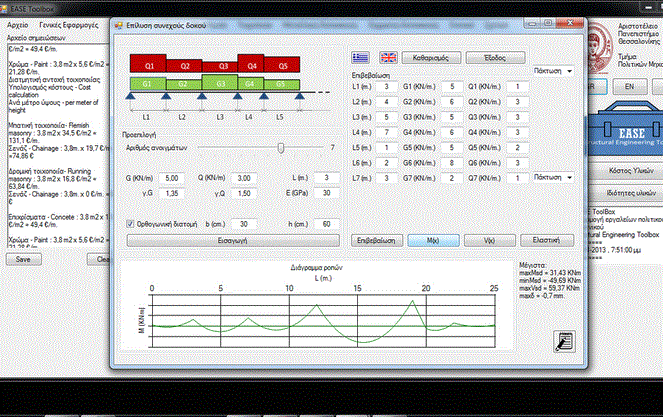
MACSAN (Masonry And Concrete Section ANalysis)  is software developed for PC that permits sectional analysis of both two-phase masonry and sections. It computes the factor of safety for given set of axial force and bending moments and provides a graphical representation of the neutral axis location and orientation. The software also provides an interface with the computer code CSI/ETABS for quick processing of multiple sections. The software is ideal for existing masonry buildings with a large number of piers that are rehabilitated with concrete jacketing.

Download 

Online Proceedings of the 4th International Conference on Building Resilience, United Kingdom

Online Proceedings of the 4th International Conference on Building Resilience, United Kingdom

The full proceedings of the 4th International Conference on Building Resilience, Incorporating the 3rd Annual Conference of the ANDROID Disaster Resilience Network has just been published in a volume of Procedia Economics and Finance, Volume 18, Pages 1-976 (2014), with full open access and indexed in Science Direct by ELSEVIER (ISSN: 2212-5671).
This volume includes selected papers presented at the 4th International Conference on Building Resilience, held in MediaCity, Salford Quays, United Kingdom from 8th – 11th September 2014. The conference was organised by: the Centre for Disaster Resilience, University of Salford, United Kingdom; the Global Disaster Resilience Centre (GDRC), University of Huddersfield, United Kingdom; and the ANDROID Disaster Resilience Network, a project of the EU Lifelong Learning Programme. 
The volume consists of 976 pages with 119 full peer reviewed research papers.  The Editorial and all 119 papers can be accessed at:http://www.sciencedirect.com/science/journal/22125671/18
This volume has been edited by Professors Richard Haigh and Dilanthi Amaratunga from Global Disaster Resilience Centre at the University of Huddersfield UK.
Further details of the 4th International Conference on Building Resilience can be found at: http://www.hud.ac.uk/research/researchcentres/gdrc/buildingresilienceconferenceseries/4thinternationalconferenceonbuildingresilience/
Multiple support seismic excitation of the Evripos bridge based on free-field and on-structure recordings

Multiple support seismic excitation of the Evripos bridge based on free-field and on-structure recordings

The 395m long Evripos bridge in central Greece, connects the island of Evia to the mainland. An accelerometer array of 43 triaxial sensors has been monitoring both the free-field excitation and the response of the superstructure in a series of seismic events since 1994. This paper focuses on the characteristics of the spatially variable, earthquake ground motions recorded during two seismic events (1999 & 2013) and the corresponding bridge response. A model updating is performed to match the numerically predicted with the measured bridge response. Then, the nature of the recorded ground motions is studied and the incoherency patterns of the seismic waves are compared with empirical or semi-empirical models. It is observed that the loss of coherency at the site is isotropic. It is also documented, for the first time based on actual free-field and on-structure recordings, that the asynchronous excitation of a bridge excited higher modes of vibration while suppressing the oscillation on its fundamental frequency. The latter is in line with analytical predictions and is believed to be a key finding in understanding the nature of spatially variable earthquake ground motion and predicting its potential impact on the seismic response of bridges.

Sextos, A., Karakostas, C., Lekidis, V., Papadopoulos, S. (2014) Multiple support seismic excitation of the Evripos bridge based on free-field and on-structure recordings, Structure and Infrastructure Engineering
Download 50 official copies from the Publisher

NYC's Risk Landscape: A Guide to Hazard Mitigation

NYC’s Risk Landscape: A Guide to Hazard Mitigation

The NYC’s Risk Landscape: A Guide to Hazard Mitigation, has been prepared by NYC’s Office of Emergency Management (OEM). It discusses hazards that NYC is exposed to, including coastal storms, coastal erosion, flooding, strong windstorms, extreme heat, winter weather, water shortage, earthquakes, and pandemic influenza.  The document is available to download from: http://www.nyc.gov/html/oem/downloads/pdf/hazard_mitigation/nycs_risk_landscape_a_guide_to_hazard_mitigation_final.pdf
International Workshop on Dynamic Analysis, Testing and Design of Infrastructure to Seismic Loads

International Workshop on Dynamic Analysis, Testing and Design of Infrastructure to Seismic Loads

Aristotle University of Thessaloniki and Bauhaus University Weimar organise a three day International Workshop on “Dynamic Analysis, Testing and Design of Infrastructure to Seismic Loads”. The Workshop will take place between 11-13 November, 2014 and is open to the engineering community. Invited Speakers and Full Program is available at: http://de-grielab.weebly.com/workshop.html

Thessaloniki to host the next European Conference on Earthquake Engineering

Thessaloniki to host the next European Conference on Earthquake Engineering

After the unanimous decision of the Executive Committee of the European Association for Earthquake Engineering, the next European Conference on Earthquake Engineering in 2018 will be held in Thessaloniki, Greece under the organization of the Hellenic Association for Earthquake Engineering. The event shall also commemorate 40 years of the major earthquake of 1978 and will take place in the Thessaloniki Concert Hall between 18-21 June 2018. The official bid document may be browsed in the following address:  http://issuu.com/milosisd/docs/thessaloniki_16ecee
Building Wizard 2.0 release: A GUI for seismic analysis of buildings using OpenSees

Building Wizard 2.0 release: A GUI for seismic analysis of buildings using OpenSees

Building Wizard is an interactive front-end software for the seismic analysis and assessment of buildings structures, that takes advantage of a sophisticated, Open-Source software for Earthquake Engineering Simulation (OpenSees) to provide through its graphical user’s interface: (a) conceptual assistance during the finite element analysis pre- and post-processing (b) finite element model development automations and (c) expert advice for modeling various building-specific issues that are key for the reliable prediction of structural response (such as shear wall connections, soil-structure interaction etc). Building Wizard improves the efficiency and credibility of the finite element modeling developed, particularly for the case of complex buildings structures and gives the designer more control in critical modeling decisions affecting the overall system response. 

Developed by: N. Psyras, D. Panagiotopoulos, N. Gantsidis
Academic Advisor: Anastasios Sextos

Download Setup file

Reconnaissance report on the dual Cephalonia Earthquake

Reconnaissance report on the dual Cephalonia Earthquake

Two major earthquakes with Mw = 6.0 and Mw = 6.1 hit the Cephalonia Island of Greece on January 26th and February 3rd of 2014, respectively.The reconnaissance mission was unique in two ways: First, it brought together the local, highly qualified earthquake engineering community, with a US collaborative team of GEER, EERI, and ATC to form a 70-people multidisciplinary team. Second, the resiliency of building stock, geostructures, and communities that responded successfully to one of the strongest sequence of ground motions ever recorded in Europe provided the opportunity to focus on collecting data of successful performance in addition to failures – a new generation of reconnaissance.
The reconnaissance report (Version 1) is available at www.geerassociation.org/GEER_Post%20EQ%20Reports/Cephalonia_Greece_2014/index.html
with observations on: (i) seismological and recorded motions; (ii) geotechnical aspects; (iii) rigid blocks behavior; (iv) structural response; (v) infrastructure lifelines; (vi) nonstructural components response; and (v) economical and societal aspects.
Correlation of pre- and post-earthquake assessment of public buildings during the 2014 Cephalonia Earthquake

Correlation of pre- and post-earthquake assessment of public buildings during the 2014 Cephalonia Earthquake

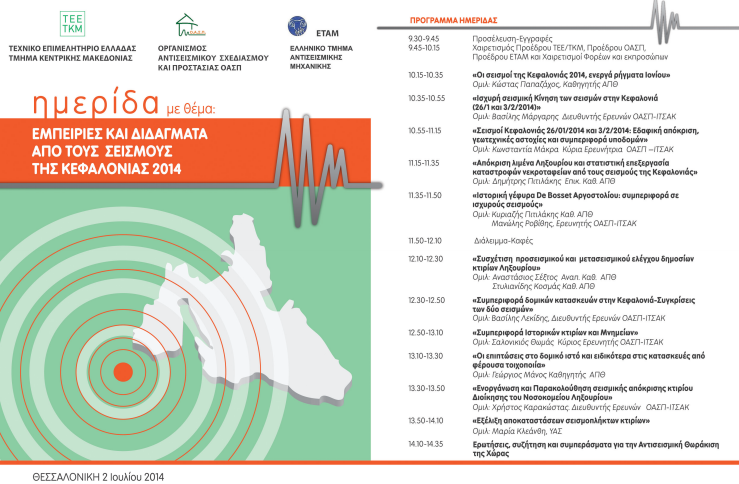
Presentation made during the Workshop about Cephalonia Earthquake jointly organised by the Society of Civil Engineers, the Hellenic Association for Earthquake Engineering, the Greek branch of the International Association for Bridge and Structural Engineering and the Organisation for Earthquake Protection and Planning.  

Presentation available in YouTube:

Enhanced by Zemanta
Kefalonia Earthquake: list of information resources

Kefalonia Earthquake: list of information resources

Special Sessions on Computational Earthquake Engineering and Bridge Engineering

Special Sessions on Computational Earthquake Engineering and Bridge Engineering

Two special sessions on on Computational Earthquake Engineering and Bridge Engineering, are organised during the Twelfth International Conference on Computational Structures Technology to be held in Naples, Italy, 2-5 September 2014. The conference runs concurrently with the Ninth International Conference on Engineering Computational Technology. Participants may attend sessions from either conference. More information on how to submit an abstract can be found here.

CST2014-S01: Computational Earthquake Engineering

The Special Session focuses on recent advances in Computational Earthquake Engineering and Structural Dynamics. More specifically, it will encourage contributions related to the mitigation of seismic risk, the design and assessment of earthquake resistant buildings and bridges, the assessment of special and monumental structures, system identification andstructural health monitoring, performance-based engineering, seismic isolation and control of structures, dynamic soil-structure interaction, strong ground motion selection and scaling as well as seismic wave propagation through the soil media. Papers related to new software applications, web-based engineering tools, frameworks for hybrid simulation and distributed computing, knowledge-based & expert systems, finite element programs, numerical analysis pre- and post- processing front-ends, data and metadata dissemination and management systems, high performance, parallel and cloud computing schemes, applications for mobile devices and tablets as well as GIS-based visualization tools are also welcome. It is envisioned that the Special Session will constitute an interesting forum for scientists using state-of-the-art computational methods and tools for Earthquake Engineering purposes.
CST2014-S03: Bridge Engineering: Modelling, Analysis and Design

The Special Session focuses on recent advances in Bridge Engineering and particularly with numerical methods for their analysis and design. More specifically, it will encourage contributions related to recent advances in Information & Communication Technologies (ICTs) and their applications in the design and assessment of bridges. It aims to review and critically demonstrate advanced numerical analysis methods, new software applications, web-based engineering tools, decision-making systems, collaborative on-site and remote research tools, frameworks for hybrid simulation (coupled experimental and numerical modules), open source finite element programs and collaborative frameworks for seismic applications, data and metadata dissemination and archiving, applications for mobile devices and remote computing, wireless data transmission and structural health monitoring, as well as earthquake- specific GIS applications. Code implications and case studies are also most welcome.

Deadline for submission of abstracts: February 15th, 2014.